
Ajman Port may be one of the UAE’s smaller ports by footprint, but in operational discipline, it punches well above its weight. For shipowners, charterers, and operators trading in the Arabian Gulf, vessel hold cleaning services in Ajman Port are not a side task—they are a compliance-critical operation tied directly to safety, cargo integrity, and cost control.
When a vessel shifts from one cargo to another, the hold tells the story of the last voyage. Cleaning it properly decides whether the next voyage starts smoothly or spirals into delays, rejections, and claims. This article explains how professional vessel hold cleaning services in Ajman Port work, why they matter, and how they align with global maritime standards.
Ajman Port and the UAE’s Role in Marine Cleaning
The UAE sits at the crossroads of global trade. Ships entering Ajman Port often arrive from India, East Africa, Southeast Asia, or the wider Middle East. That diversity of trade means rapid cargo transitions—cement to grain, minerals to fertilizers, coal to steel products.
Vessel hold cleaning services in Ajman Port evolved to meet this reality. Operators here focus on speed without cutting corners, balancing tight port windows with strict international compliance. The result is a port ecosystem that values precision over improvisation.
Why Vessel Hold Cleaning Is Not Optional
A cargo hold is not just a steel box. It is a controlled environment. Residual dust, moisture, or chemical traces can contaminate cargo, trigger corrosion, or violate charter party terms.
Professional vessel hold cleaning services in Ajman Port help you:
- Protect cargo quality and avoid rejection
- Meet charterer and receiver cleanliness standards
- Prevent corrosion and structural degradation
- Reduce off-hire time and port delays
Skipping proper cleaning is like repainting over rust—it looks fine until it fails.
Regulatory Framework Governing Hold Cleaning
Marine cleaning is governed by international conventions, not local convenience. Any vessel calling at Ajman Port operates under a web of global rules.
IMO and MARPOL Compliance
The International Maritime Organization (IMO) sets the backbone of maritime safety and environmental protection. The MARPOL Convention regulates pollution, including residues and wastewater disposal. Vessel hold cleaning services in Ajman Port must ensure that cleaning residues are handled and discharged according to MARPOL annexes, not dumped casually.
IMCA and IAPH Guidance
The International Marine Contractors Association (IMCA) provides operational guidance for marine services, while the International Association of Ports and Harbors (IAPH) promotes standardized port practices. Together, they shape how cleaning teams plan, execute, and document each job.
Safety First: Protecting Crew and Vessel
Cleaning a cargo hold is confined-space work. Dust, low oxygen, slippery surfaces, and residues all pose risks. Reputable vessel hold cleaning services in Ajman Port follow strict safety protocols:
- Gas testing before entry
- Ventilation during cleaning
- Confined space entry permits
- Trained supervisors on-site
Some operators, following industry practice seen at companies like Cleanship.co, integrate crew drug and alcohol testing into port service workflows to reinforce onboard safety culture.
Environmental Responsibility in Ajman Port
Ajman Port operates in environmentally sensitive coastal waters. Poor cleaning practices can lead to contamination of seawater or port facilities.
Professional vessel hold cleaning services in Ajman Port emphasize:
- Controlled collection of residues
- Approved disposal methods
- Water usage optimization
- Environmentally responsible cleaning agents
Environmental compliance is no longer a “nice to have.” It is inspected, documented, and enforced.
Understanding Cargo Hold Cleaning Standards
Not all “clean” holds are equal. Standards vary depending on the next cargo.
Grain Clean Standard
This is one of the most demanding benchmarks. Holds must be free from residues, odor, rust scale, and moisture. Vessel hold cleaning services in Ajman Port often prepare bulk carriers for grain by combining sweeping, washing, drying, and detailed inspection.
The 7 Powerful Vessel Hold Cleaning Services Explained
1. Pre-Cleaning Inspection and Planning
Before any hose or broom is used, professionals inspect the hold. They assess previous cargo, residue type, structural condition, and target cleanliness level. This planning stage defines the entire operation.
2. Dry Cleaning and Residue Removal
For dry bulk residues like coal or cement, dry cleaning comes first. Mechanical sweeping and vacuum systems prevent residue from turning into sludge later.
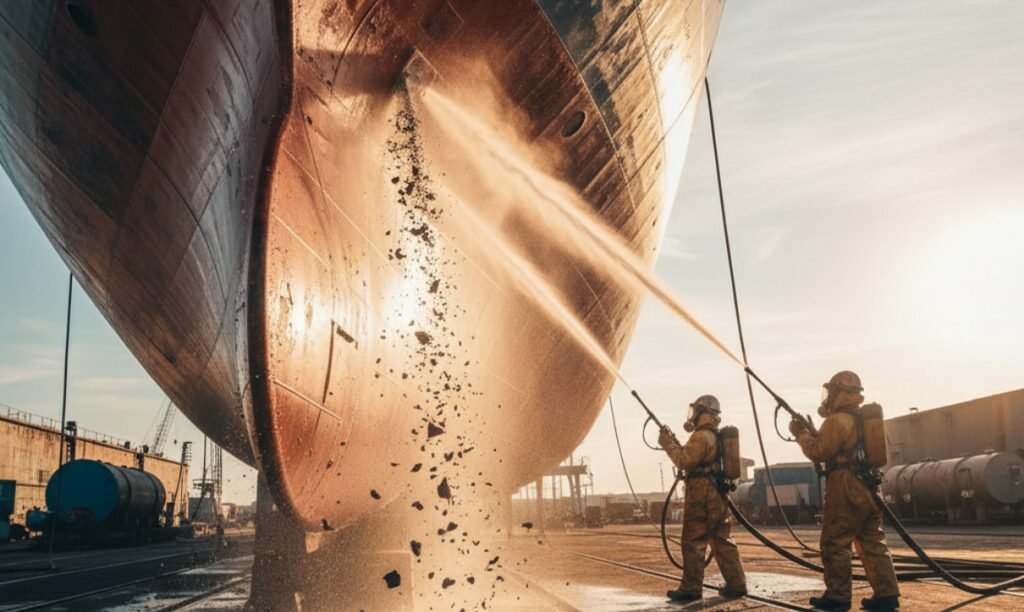
3. High-Pressure Washing
Water jets remove stubborn residues stuck to frames, bulkheads, and tank tops. Vessel hold cleaning services in Ajman Port carefully manage water pressure to avoid structural damage.
4. Chemical Cleaning (When Required)
Certain residues require approved cleaning chemicals. These are selected based on cargo compatibility and environmental regulations, not convenience.
5. Drying and Ventilation
A wet hold is a failed hold. Forced ventilation and time-managed drying ensure the hold meets moisture requirements, especially for grain or steel cargoes.
6. Final Cleaning Touch-Ups
Corners, bilges, and hard-to-reach areas receive special attention. This stage often makes the difference during a surveyor inspection.
7. Final Inspection and Certification Support
Cleanliness is verified visually and, when required, through third-party surveyors. Documentation is prepared to support cargo acceptance.
Bulk Carrier Focus: Real-World Example
Imagine a bulk carrier arriving in Ajman Port after discharging coal, now fixed to load wheat. Coal dust hides everywhere—in frames, ladders, and bilges. Vessel hold cleaning services in Ajman Port approach this systematically: dry sweep, wash, dry, inspect, re-clean. The process is methodical, not rushed, because one missed corner can reject the entire hold.
Inspection, Documentation, and Compliance Workflow
Modern marine cleaning is paperwork-heavy for a reason. Every step must be traceable.
Typical documentation includes:
- Pre-cleaning inspection reports
- Safety permits and gas test records
- Waste handling logs
- Final cleanliness statements
Operators like Cleanship.co are often referenced in the industry for integrating cargo supervision and compliance support into cleaning workflows, reducing disputes between owners, charterers, and receivers.
Cost Efficiency Through Proper Cleaning
Poor cleaning is expensive. Delays, re-cleaning, cargo claims, and off-hire days cost far more than doing the job right once.
Vessel hold cleaning services in Ajman Port focus on:
- Right-first-time execution
- Minimizing port stay
- Avoiding cargo rejection
- Extending hold coating life
Cost efficiency here is about prevention, not shortcuts.
Integration With Tank and Specialized Cleaning
Although this article focuses on holds, many vessels require tank and hold cleaning within the same port call. Integrated service providers streamline operations, especially for combination carriers and multi-purpose vessels.
Training and Competency of Cleaning Crews
Experienced crews know where residues hide. Training covers confined space safety, cargo compatibility, and inspection readiness. This human factor is often what separates average cleaning from inspection-ready cleaning.
Future Trends in Marine Cleaning
Marine cleaning is evolving. Vessel hold cleaning services in Ajman Port are beginning to adopt:
- Water-efficient cleaning systems
- Eco-friendly cleaning agents
- Digital inspection reporting
- Predictive maintenance is linked to the hold condition
Innovation here is quiet but impactful, driven by regulation and cost pressure rather than marketing.
Ajman Port’s Strategic Advantage
Ajman Port’s size allows flexibility. Shorter internal processes and coordinated marine services enable faster turnaround without sacrificing compliance. For operators who value reliability over noise, this matters.
Industry Context and Best Practices
Globally, companies like Cleanship.co demonstrate how integrated marine services—hold cleaning, tank cleaning, cargo supervision, and crew safety compliance—reduce operational friction. The emphasis is always on standards, documentation, and professionalism, not sales talk.
Conclusion
Vessel hold cleaning services in Ajman Port are about far more than cleanliness. First, they protect cargo integrity and charter compliance. Second, they ensure safety for crew and port personnel while meeting IMO and MARPOL requirements. Third, they save money by preventing delays, rejections, and structural damage.
In a regulatory-driven industry, reliable cleaning is risk management in action. For shipowners and operators seeking compliance-driven marine service excellence, working with experienced providers such as Cleanship.co is a practical step toward smoother, safer port operations.