










- Your cart is empty Browse Shop
18
May, 26
7 Critical Reasons Sea Chest Cleaning & Hull Fouling Inspection Must Be Part of Every Vessel Maintenance Plan
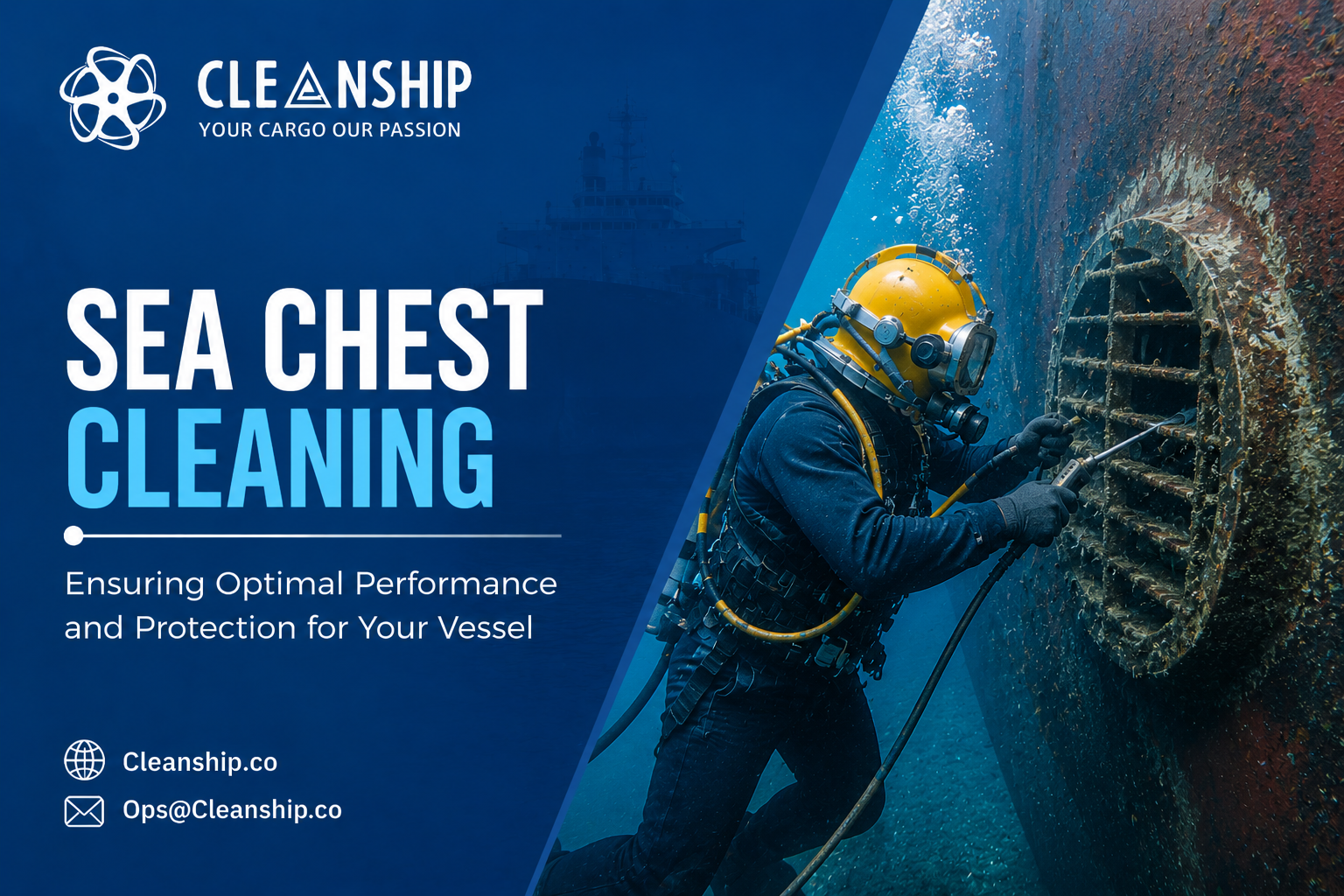
The Most Overlooked Maintenance Task in Commercial Shipping Ask most fleet managers to list their top underwater maintenance priorities, and they will say hull cleaning, propeller polishing, and anode replacement. Sea chest cleaning rarely makes the top three. That is a costly blind spot. A sea chest is the underwater inlet box through which seawater enters the vessel’s cooling system, supplying the main engine, auxiliary engines, air conditioning systems, and ballast pumps. It is protected by a grating or grid that filters debris from the incoming water flow. In warm, biologically active waters—precisely the conditions in Dubai, Singapore, Mumbai, Istanbul, and Hong Kong—that grating becomes a prime site for heavy biofouling. Barnacles, mussels, tube worms, and algae colonize the sea chest grid within weeks, progressively restricting the cooling water supply. Think of a blocked sea chest the same way you would think of a blocked radiator in a truck engine. The truck still moves—until the engine overheats and the driver is stranded on the motorway. A vessel with a blocked sea chest still sails—until the main engine cooling alarm fires in the middle of a passage and the master has no choice but to reduce speed or stop. That is when the real cost begins: emergency repairs, off-hire losses, charterer claims, and port state control scrutiny. All of it avoidable with a routine sea chest cleaning programme paired with professional hull fouling inspection. At Cleanship Marine Services, we provide expert sea chest cleaning and hull fouling inspection at eight of the world’s most commercially demanding ports: Dubai, Athens, Singapore, Hong Kong, London, Hamburg, Istanbul, and Mumbai. Here is why this service belongs in every vessel’s planned maintenance system. Request A Quote Why the UAE and Global Ports Are Raising the Bar on Sea Chest Cleaning Warm Waters and Accelerated Biofouling The UAE sits at the northern end of the Arabian Gulf—one of the warmest and most biologically productive bodies of water on the planet. Sea surface temperatures in the Gulf frequently exceed 30°C during summer months, creating ideal conditions for rapid marine growth. A vessel calling at Jebel Ali or Rashid Port in Dubai can accumulate significant sea chest fouling within a single port call. The same accelerated fouling conditions apply to Mumbai, Singapore, and Hong Kong, where tropical and subtropical water temperatures drive year-round biological activity. Strict Port Environmental Expectations Port authorities in Hamburg, London, and Singapore are increasingly scrutinizing biofouling management documentation. The transfer of invasive species through fouled sea chests and hull surfaces is a growing regulatory focus. Cleanship’s sea chest cleaning operations include MARPOL-compliant debris containment, ensuring no biological material is released into port waters. Class Society Requirements Classification societies—Lloyd’s Register, Bureau Veritas, DNV, and others—include sea chest condition assessments within their in-water survey programs. A poorly maintained sea chest with heavy fouling or corrosion can trigger a survey finding that requires immediate rectification, potentially delaying the vessel’s departure from ports like Piraeus (Athens), Hamburg, or Istanbul. What Is Sea Chest Cleaning? (A Simple Explanation) A sea chest is a recessed chamber in the vessel’s hull, open to the sea, through which seawater is drawn into the ship’s cooling and ballast systems. It is protected externally by a grating or grid — typically steel or GRP — designed to prevent debris from entering the piping. Sea chest cleaning is the systematic removal of marine growth, biofouling, sediment, and corrosion products from the sea chest chamber, its grating, the surrounding hull plating, and the accessible sections of the inlet pipes. Trained commercial divers access the sea chest from outside the vessel while it floats in the harbor, using scraping tools, water jetting equipment, and brushing systems to restore the free area of the grating and the internal surfaces of the chest. A clean sea chest ensures that cooling water flows at the volume and pressure the vessel’s systems were designed to receive. It also removes the biological material that—left unchecked—corrodes steel, clogs pipework, and hosts organisms that will be carried into the vessel’s internal piping if the grating is compromised. What Is Hull Fouling Inspection? (And Why It Accompanies Every Clean) Hull fouling inspection is the systematic underwater examination of a vessel’s hull surfaces to assess the type, distribution, and severity of biofouling and associated coating condition. It is performed by trained divers using visual examination methods, HD-CCTV equipment, and photographic documentation. Hull fouling inspection answers four questions that every ship operator needs to answer regularly: Hull fouling inspection without sea chest cleaning is incomplete. Sea chest cleaning without a surrounding hull fouling inspection misses the context that makes the data actionable. Cleanliness is provided as a standard combined service at all eight of our target ports. Regulatory Framework Governing Sea Chest Cleaning Globally IMO Biofouling Management Guidelines (MEPC.207(62) and MEPC.378(80)) The International Maritime Organization’s biofouling management guidelines apply directly to sea chest management. Sea chests are specifically identified as a high-risk biofouling niche area requiring targeted management under the IMO framework. The updated 2023 guidelines (MEPC.378(80)) have strengthened expectations around documentation and niche area management plans. MARPOL Convention (Annex V and Annex VI) MARPOL regulates the handling and disposal of residues generated during sea chest cleaning and hull fouling inspection operations. Biological material, paint particles, and debris must be collected and disposed of in compliance with Annex V. Cleanship’s debris containment systems are designed to meet these requirements at all eight target ports. Port-Specific Biosecurity Regulations Several of our target ports apply biosecurity regulations that go beyond the IMO baseline. The Maritime and Port Authority of Singapore (MPA) has active frameworks around biofouling and invasive species. The Port of Hamburg Authority enforces environmental compliance around underwater cleaning operations. Cleanship maintains operational procedures aligned with each port’s specific requirements. Class Society In-Water Survey Standards Classification societies require sea chest conditions to be assessed as part of in-water surveys conducted in lieu of drydock. IACS (International Association of Classification Societies) member societies have consistent expectations around sea chest grating free area, corrosion condition, and fouling management documentation.