India’s Biofouling Problem and Why It Demands a Professional Solution
Every vessel trading on India’s coastline is fighting an invisible battle from the moment it enters Indian waters. Below the waterline, in the warm nutrient-rich waters that stretch across 7,516 kilometers of Indian coastline
A biological process begins immediately—and it does not stop until the vessel’s hull is cleaned.
That process is ship hull biofouling: the colonization of the vessel’s underwater surfaces by marine organisms, including bacteria, algae, barnacles, mussels, tube worms, and hydroids. It begins with a microscopic slime layer within hours of a clean hull surface touching seawater. Within weeks, hard macro-fouling organisms have established themselves. Within months — or even sooner during peak monsoon and post-monsoon conditions
Heavily fouled hull can be carrying several tonnes of biological material, each kilogram adding drag, increasing fuel burn, accelerating corrosion, and carrying living invasive species from one trading port to the next.
India’s maritime geography makes this challenge particularly acute. From Kandla in Gujarat to Kolkata in West Bengal, from Cochin in Kerala to Port Blair in the Andaman Islands
India’s 32 major commercial ports operate in waters where sea surface temperatures stay above 26°C for most of the year and biological productivity is among the highest in the world. No antifouling paint system—however well-specified and applied—can fully prevent fouling under these conditions without active maintenance. Moreover, even high-performance coatings are subject to environmental limitations in challenging marine environments.
In addition, warm, nutrient-rich waters can accelerate the settlement and growth of fouling organisms. Furthermore, coating effectiveness naturally declines over time as vessels continue operating. At the same time, varying operating patterns and port conditions can influence fouling rates significantly. Additionally, prolonged periods at anchor may further increase the likelihood of marine growth accumulation.
As a result, some degree of fouling remains inevitable despite the use of advanced coating technologies. Consequently, regular inspection and maintenance are essential for preserving vessel performance and efficiency. Likewise, proactive cleaning programmes help maximize the benefits of antifouling systems throughout their service life. Therefore, active maintenance remains a critical component of any effective fouling management strategy.
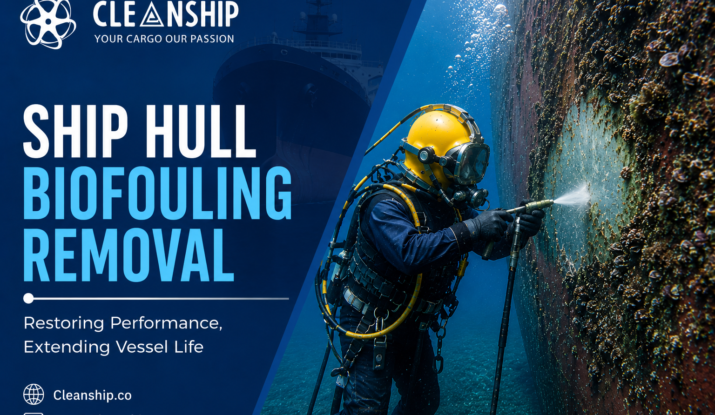
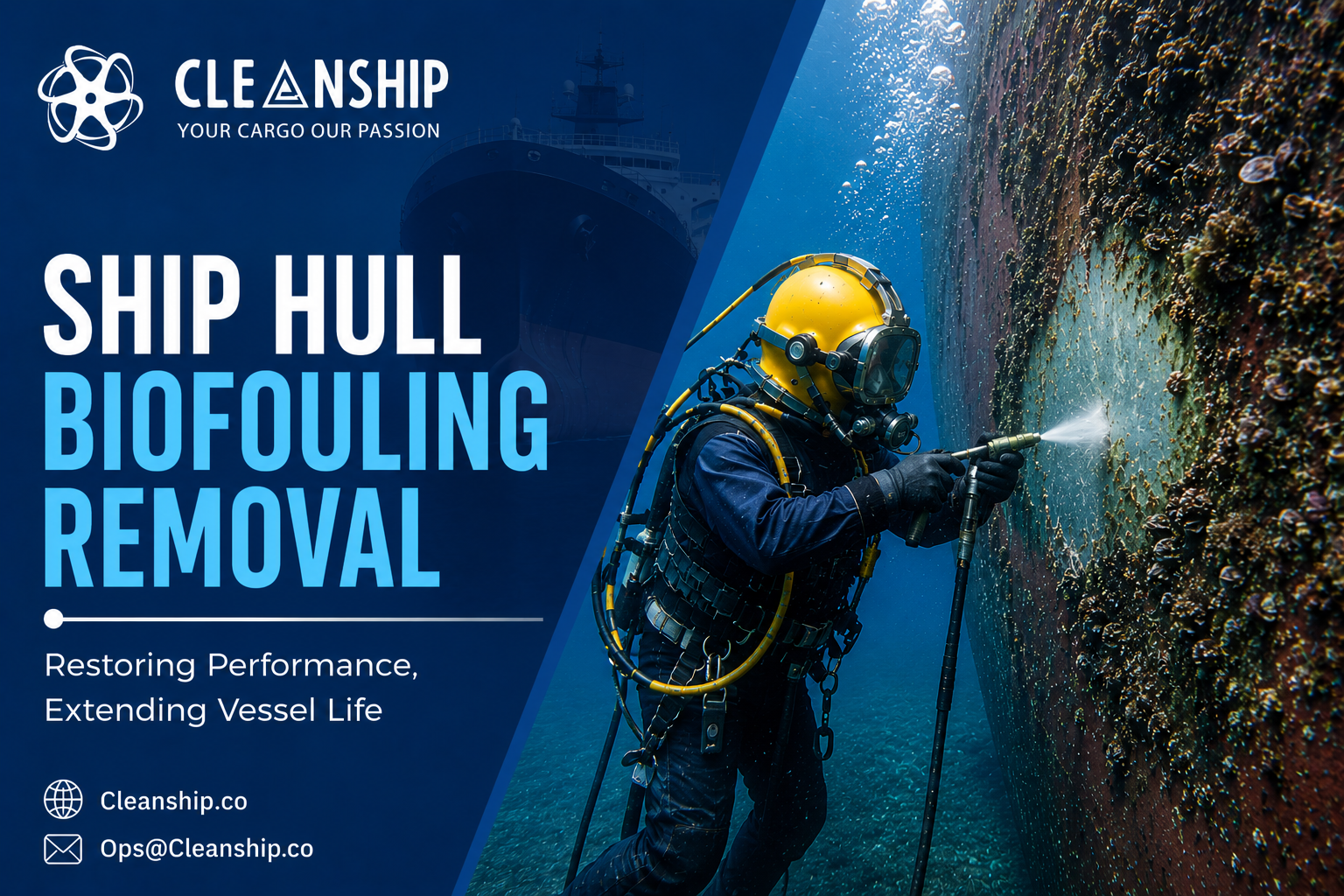
This is where professional ship hull biofouling removal and ROV hull inspection become essential tools for every Indian coastal fleet operator. Biofouling removal by trained dive teams or remote-operated vehicles restores hull hydrodynamic performance. ROV hull inspection — using high-definition underwater cameras, lights, and positioning systems — gives operators the condition visibility they need to manage hull maintenance intelligently across India’s entire major port network.
At Cleanship Marine Services, we provide both services at all 32 of India’s major commercial ports, 24 hours a day, 7 days a week.
This complete guide explains why these services matter, how they work, and what they deliver for vessels operating on one of the world’s most biologically demanding trading coastlines.
Understanding Ship Hull Biofouling: What It Is, How It Forms, and What It Costs
Ship hull biofouling is not a single event—it is a progressive biological process that unfolds in distinct stages, each one building on the last. In addition, the process begins almost immediately after a vessel enters the water. Moreover, each stage creates conditions that encourage the development of the next stage. Furthermore, microscopic organisms initially colonize the hull surface and form a biological foundation for future growth.
At the same time, changes in surface chemistry make the hull increasingly attractive to additional marine species. Additionally, algae, bacteria, and other microorganisms gradually establish stable communities on submerged surfaces. Besides that, these early colonizers facilitate the attachment of larger fouling organisms. Likewise, barnacles, mussels, and other macrofouling species can settle more easily once the initial biofilm is present. Similarly, the accumulation process accelerates as biological layers become thicker and more complex. As a result, hull roughness increases and hydrodynamic performance begins to decline.
Consequently, vessels may experience higher fuel consumption and reduced operational efficiency. For this reason, understanding each stage of biofouling is essential for effective prevention and maintenance planning. Ultimately, early intervention can prevent minor biological settlement from developing into severe fouling. Therefore, recognizing biofouling as a staged and continuous process is critical for maintaining vessel performance, compliance, and operational efficiency.
Stage 1: Conditioning Film (Minutes to Hours)
Within minutes of a clean hull surface being immersed in seawater, dissolved organic molecules — proteins, polysaccharides, lipids — adsorb onto the surface and form a thin conditioning film.
This film is invisible, but it fundamentally changes the surface chemistry of the hull, making it far more hospitable to microbial colonization. In addition, the altered surface conditions encourage microorganisms to attach more easily. Moreover, this initial microbial layer serves as the foundation for further biofouling development. Furthermore, once established, the film creates an environment that supports the growth of additional marine organisms. At the same time, the process often begins long before visible fouling can be detected during routine observations.
Additionally, the changing surface characteristics increase the likelihood of continued biological accumulation. Besides that, the film can accelerate the transition from a clean hull to an actively colonized surface. Likewise, microorganisms within the layer can promote the settlement of larger fouling species. Similarly, favorable surface conditions may contribute to faster fouling progression in warm and nutrient-rich waters.
As a result, marine growth can develop more rapidly than vessel operators anticipate. Consequently, hull performance and hydrodynamic efficiency may begin to decline over time. For this reason, early monitoring and preventive maintenance play an important role in fouling management. Ultimately, understanding the impact of this microscopic film is essential for maintaining long-term vessel performance. Therefore, even though the film remains invisible, its effect on biofouling development can be highly significant.
Stage 2: Bacterial Biofilm — The Slime Layer (Hours to Days)
Bacteria and diatoms settle on the conditioned surface and begin multiplying, forming a structured biofilm—the marine slime layer. This layer is typically between 10 and 300 micrometers thick and appears as a faint, slightly rough discoloration on the hull surface. It increases hull roughness measurably and, critically, signals to larval macro-fouling organisms that the surface is suitable for settlement.
Stage 3: Micro-Algae and Protozoa (Days to Weeks)
Unicellular algae and protozoa join the biofilm, thickening it and enriching its biological composition. The hull surface is now actively biological—a living community that secretes signaling molecules attracting the larvae of larger fouling organisms.
Stage 4: Macro-Fouling Settlement (Weeks to Months)
The larvae of barnacles, mussels, tube worms, hydroids, and bryozoans settle on the biofilm and begin their permanent attachment. In Indian tropical waters, barnacle larvae can settle and begin forming visible calcite shells within 2–4 weeks of first contact with a suitable biofilm surface. Mussel settlement follows a similar timeline in high-nutrient coastal zones such as those at Mundra, Haldia, and Paradip.
Stage 5: Established Macro-Fouling Community (Months Onwards)
Left unmanaged, the macro-fouling community grows into a complex, layered biological reef on the hull surface. Barnacles in Indian waters can reach diameters of 20–30mm within three months. Mussel colonies can cover large areas of the flat bottom and bilge keel areas. Tube worms and hydroids fill the spaces between hard fouling organisms. The total drag penalty at this stage can reach 25–40% above the drag of a clean hull.
The Financial Cost of Unmanaged Biofouling
For a medium-sized bulk carrier operating on Indian coastal routes—say, a 40,000 DWT Handymax trading between Mumbai, Mormugao, New Mangalore, Cochin, Tuticorin, Visakhapatnam, and Paradip—the financial cost of unmanaged biofouling includes the following:
- Additional fuel consumption:
- At a 15% fuel penalty on a vessel burning 20 tonnes of fuel per day, the additional fuel cost at $600/tonne is $1,800 per day—approximately $657,000 per year
- Reduced cargo competitiveness:
- Higher bunker costs mean higher freight rates needed to break even, reducing the vessel’s commercial competitiveness against better-maintained fleet competitors
- Accelerated drydock costs:
- Coating damage from unmanaged biofouling shortens the antifouling coating service life, bringing forward the next expensive drydock recoating
- IMO CII rating deterioration:
- Higher fuel consumption per tonne-mile directly worsens the vessel’s Carbon Intensity Indicator (CII) rating, with commercial and regulatory consequences under India’s growing maritime decarbonisation framework
Professional ship hull biofouling removal addresses all of these costs in a single planned operation.
What Is ROV Hull Inspection? A Plain-Language Technical Explanation
An ROV hull inspection is an underwater examination of a vessel’s submerged surfaces conducted using a Remotely Operated Vehicle —
An unmanned underwater robot equipped with high-definition cameras, powerful lights, thrusters, and positioning systems is used instead of human divers. In addition, this advanced technology enables detailed underwater inspections in a wide range of operating conditions. Moreover, high-definition cameras provide clear visual data for accurate condition assessments. Furthermore, powerful lighting systems improve visibility in low-light or turbid underwater environments. At the same time, integrated thrusters allow the vehicle to maneuver precisely around complex hull structures and submerged equipment.
Additionally, positioning systems help operators maintain accurate location tracking throughout the inspection process. Besides that, remotely operated vehicles can access areas that may be difficult or hazardous for divers to reach. Likewise, real-time video transmission allows inspection teams to evaluate findings immediately.
Similarly, collected data can be recorded and reviewed for maintenance planning and compliance purposes. As a result, inspections can be completed with greater consistency and operational efficiency. Consequently, vessel operators gain valuable information while reducing dependence on diver-based operations. For this reason, ROV technology has become an increasingly preferred solution for underwater inspection and maintenance activities. Ultimately, it enhances safety, improves data quality, and supports more effective asset management. Therefore, the use of advanced underwater robots provides a reliable and efficient alternative to traditional diving operations.
The ROV is operated from the surface by a trained technician, who controls its movement along the hull surface and observes the live HD video feed on a surface monitor.
The video is simultaneously recorded for documentation and reporting purposes.
What an ROV Hull Inspection Can See
A modern ROV hull inspection system, properly operated, can document:
- Fouling type and severity across all accessible hull areas — classifying slime, weed, barnacle, mussel, and mixed fouling communities
- Antifouling coating condition — polishing rate assessment, coating erosion, blistering, mechanical damage, and primer exposure
- Corrosion and pitting — identifying localised corrosion, waterline wastage, and any areas of plating thinning visible to camera
- Structural damage — dents, cracks, weld line deterioration, mechanical contact damage from port equipment or groundings
- Sea chest condition—grating-free area, fouling inside the chest, external plating corrosion around the inlet
- Anode wastage — recording the remaining mass of sacrificial anodes and any anodes that have detached or been mechanically damaged
- Rudder condition — lower rudder corrosion, drain plug condition, pintle area inspection
- Propeller blade condition — blade surface fouling, erosion, cavitation damage, and mechanical damage
- Bilge keel condition — weld integrity and corrosion along the bilge keel attachment
When ROV Hull Inspection Is the Right Tool
ROV hull inspection is particularly valuable in situations where diver operations are difficult, dangerous, or impractical:
- Low-visibility conditions — monsoon season port waters (particularly at Cochin, Mormugao, New Mangalore, Hazira, and Mumbai between June and September)
- Deep-draught vessels—where diver access to the flat bottom requires exceptional bottom clearance
- Confined niche areas — sea chest interiors, bow thruster tunnels, and narrow stern frame recesses where diver entry is restricted
- Pre-cleaning condition assessment — recording the hull’s biofouling state before cleaning begins, for documentation and comparison purposes
- Post-cleaning verification — confirming that biofouling removal has been effective across the full hull surface
- UWILD inspection support — providing the camera documentation required for classification society hull surveys
ROV hull inspection does not replace professional divers for physical cleaning operations—for ship hull biofouling removal, trained divers with rotating brush systems remain the primary operational tool. However, ROV inspection provides an inspection and documentation capability that extends what divers can see, reach, and record. In addition, advanced camera systems capture high-quality visual data for detailed analysis.
Moreover, ROVs can access areas that may be difficult or impractical for divers to inspect thoroughly. Furthermore, extended operational durations allow for more comprehensive underwater assessments. At the same time, real-time video feeds enable technical teams to review findings immediately. Additionally, recorded footage creates a permanent inspection record for future reference and comparison. Besides that, ROV technology enhances consistency in documentation and reporting processes. Likewise, inspection data can be shared easily with vessel owners, managers, and classification societies.
As a result, decision-making becomes more informed and evidence-based. Consequently, maintenance planning and asset management can be carried out more effectively. For this reason, ROV inspections are increasingly used alongside traditional diving operations. Ultimately, they provide greater visibility, broader coverage, and more detailed documentation of underwater assets. Therefore, ROV inspection significantly expands the inspection and recording capabilities available beyond what divers alone can typically achieve.
Why Ship Hull Biofouling Removal and ROV Hull Inspection Must Always Work Together
The most common — and most costly — operational error in hull maintenance is treating biofouling removal and hull inspection as separate, independent activities.
Here is why this error matters:
A fouled hull cannot be properly inspected. Marine growth conceals the coating and plating beneath it. An ROV hull inspection or hull fouling inspection conducted on a vessel with heavy biofouling will show fouling — but will not show the coating condition, corrosion, or structural anomalies hidden beneath it. The inspection produces incomplete data and may miss serious findings.
A cleaned hull without inspection wastes the opportunity. The window immediately after ship hull biofouling removal is the only time during the vessel’s operational life when the full underwater surface is clean, accessible, and visible — without the cost and disruption of drydock.
Every vessel that undergoes biofouling removal without an ROV hull inspection or hull fouling inspection at the same time is missing the most cost-effective condition assessment opportunity available to it.
One mobilization, maximum output. Calling the dive team and ROV equipment to the vessel twice — once for cleaning and once for inspection — doubles costs and doubles schedule disruption. Combining ship hull biofouling removal with ROV hull inspection and hull fouling inspection in a single planned mobilization delivers cleaning, condition data, and compliance documentation in one operation.
Cleanship’s standard operational approach at all 32 Indian port locations is to combine ship hull biofouling removal with ROV hull inspection, hull fouling inspection, and underwater hull cleaning verification in a single integrated operation — with the ROV conducting pre-clean and post-clean passes to document both the starting condition and the cleaning outcome.
The Regulatory Environment Governing Hull Biofouling in India
Directorate General of Shipping (DGS)
The Directorate General of Shipping administers India’s maritime regulatory framework, implementing IMO conventions through Indian domestic legislation. DGS port state control inspections at Indian ports—conducted under the Tokyo MOU regime—increasingly include review of biofouling management documentation, particularly for vessels making repeated Indian port calls.
IMO Biofouling Management Guidelines (MEPC.207(62) and MEPC.378(80))
The IMO’s biofouling management guidelines require vessels to maintain a biofouling management plan and a biofouling record book. Sea chests, bow thruster tunnels, bilge keels, and rudder niche areas are specifically identified as high-risk areas requiring targeted management. The 2023 updated guidelines (MEPC.378(80)) strengthen documentation requirements significantly—relevant for all vessels calling at Indian ports from Kandla to Kolkata.
India’s Maritime Vision 2030 and Harit Nauka (Green Shipping) Policy
The Indian government’s Maritime India Vision 2030 and Harit Nauka green shipping policy framework identify hull efficiency as a component of maritime decarbonization. Regular ship hull biofouling removal is increasingly expected as evidence of environmental performance under this framework, alongside EEXI and CII compliance reporting.
IMO CII (Carbon Intensity Indicator) Framework
Since January 2023, vessels of 5,000 GT and above must calculate and report their CII annually. Hull fouling directly increases fuel consumption per cargo tonne-mile — worsening the CII rating. Regular biofouling removal is now both a maintenance service and a regulatory compliance tool for vessels subject to the CII framework on Indian coastal trades.
MARPOL Convention (Annex V)
The disposal of biological residues, paint particles, and water generated during ship hull biofouling removal must comply with MARPOL Annex V requirements. Uncontrolled discharge of cleaning residues into port waters is prohibited at all Indian major ports. Cleanship deploys MARPOL-compliant debris containment systems at every operation.
Classification Society Requirements (IRS, LR, DNV, BV, ClassNK)
The Indian Register of Shipping (IRS) — headquartered in Mumbai and active at all major Indian ports — and other IACS member classification societies require vessels to demonstrate that hull condition meets class requirements between drydock intervals. ROV hull inspection and UWILD inspection provide the survey evidence that satisfies this requirement without drydocking.
Benefit 1: Measurable Fuel Efficiency Recovery on Every Indian Coastal Voyage
The most immediate and quantifiable benefit of professional ship hull biofouling removal is the restoration of the vessel’s designed hull hydrodynamic efficiency—and the fuel consumption reduction that follows.
The relationship between biofouling and fuel consumption is well-documented across the maritime industry. The drag penalty from progressive fouling accumulation follows a consistent pattern in warm-water trading environments like India’s coastal routes:
| Fouling Stage | Fouling Description | Typical Fuel Consumption Increase |
|---|---|---|
| Clean — Light Slime | Micro-fouling only; smooth visible surface | 1–5% |
| Moderate Fouling | Weed and early barnacle settlement to 3mm | 8–15% |
| Heavy Fouling | Established barnacle and mussel colonies to 20mm | 20–30% |
| Severe Fouling | Dense hard fouling above 20mm with coating damage | 35–45%+ |
For a vessel operating on a typical Indian coastal trading pattern — Kandla → Mumbai → Mormugao → Cochin → Tuticorin → Visakhapatnam → Paradip → Haldia — the round voyage distance is approximately 4,800 nautical miles. At a 20% fuel penalty for heavy fouling on a vessel burning 18 tonnes per day, the additional bunker cost on a single round voyage exceeds $13,000. Multiplied across 8 to 10 voyages per year, the annual additional fuel cost from a single unmanaged fouling cycle exceeds $100,000.
Professional ship hull biofouling removal by Cleanship, combined with propeller polishing — which independently recovers a further 4–8% of propulsion efficiency — delivers a combined fuel performance recovery that consistently pays back the cost of the operation within two to three voyages on Indian coastal trades.
Benefit 2: ROV Hull Inspection — Seeing What the Naked Eye Cannot Reach
The underwater surface of a commercial vessel is large, complex, and largely invisible during normal operation. A 40,000 DWT bulk carrier has approximately 4,500 square meters of submerged hull surface area, including
- The flat bottom: the widest single area, often carrying the heaviest fouling in ships at anchor
- The bilge keel areas: shielded recesses that trap biofouling and resist cleaning tool access
- The stern frame and rudder recess: a complex geometry that creates dead-water zones ideal for fouling accumulation
- The sea chests: enclosed chambers that are among the most fouling-aggressive niche areas on the vessel
- The bow thruster tunnel: a confined space with specific fouling and corrosion patterns
- The waterline band: subject to cyclical wetting and drying that produces a unique fouling and corrosion pattern
A professional ROV hull inspection by Cleanship systematically examines all of these areas with HD camera and lighting equipment, producing a documented record of hull condition that no visual inspection from the deck or pier can match. The ROV reaches areas that divers cannot safely access, operates in low-visibility conditions that restrict diver effectiveness, and produces a permanent video record that can be reviewed, shared with technical superintendents, and submitted to classification societies — all features that a diver’s verbal report cannot replicate.
ROV hull inspection is particularly powerful when combined with underwater hull cleaning on the same dive operation. A pre-clean ROV pass records the starting biofouling condition. The cleaning team then conducts ship hull biofouling removal. A post-clean ROV pass verifies the cleaning result, documents the now-visible coating condition, and records any structural or anode findings exposed by the removal of biological material.
The before-and-after record produced by this workflow is one of the most valuable documents a technical superintendent can hold. In addition, it provides clear visual evidence of the vessel’s condition before and after maintenance activities. Moreover, the documentation helps verify that cleaning, inspection, or repair work has been completed as planned. Furthermore, it creates a reliable reference point for future maintenance decisions and performance evaluations.
At the same time, the record supports greater transparency between vessel operators, contractors, and stakeholders. Additionally, photographic and video evidence can assist in identifying trends in fouling, coating condition, and structural integrity. Besides that, the documentation may support compliance requirements and class-related reporting obligations. Likewise, it can be used to assess the effectiveness of maintenance strategies over time. Similarly, historical records help technical teams compare vessel conditions across multiple inspection cycles.
As a result, maintenance planning becomes more data-driven and efficient. Consequently, operators can make more informed decisions regarding repairs, cleaning intervals, and asset management.
For this reason, comprehensive before-and-after documentation is considered a critical component of modern vessel maintenance programmes. Ultimately, it strengthens accountability, improves operational oversight, and enhances long-term fleet management. Therefore, the before-and-after record remains one of the most valuable resources available to a technical superintendent.
Benefit 3: Hull Fouling Inspection to Prevent Small Problems from Becoming Drydock Emergencies
Hull fouling inspection—the structured assessment of biofouling type, distribution, and severity across the vessel’s hull—is the intelligence-gathering function that makes ship hull biofouling removal a managed programme rather than a reactive emergency response.
Without regular hull fouling inspection, operators are managing blind. They do not know:
- Whether the antifouling coating is performing within its designed parameters or failing prematurely
- Whether biofouling is concentrated in specific niche areas (sea chests, rudder recess, bilge keels) that are causing disproportionate drag or equipment risk
- Whether corrosion is developing in areas beneath biofouling communities that will require steel renewal at the next drydock
- Whether the current cleaning interval is appropriate for the vessel’s trading area and fouling accumulation rate
Regular hull fouling inspection by Cleanship — using structured fouling rating assessments based on IMO biofouling categories and NSTM 6342 or equivalent scales — provides this intelligence systematically. The inspection findings drive three critical decisions:
Decision 1 — Cleaning interval. If the hull fouling inspection shows heavy fouling accumulating faster than expected, the cleaning interval is shortened. If fouling is light, the interval can be extended, saving cleaning costs without compromising performance.
Decision 2 — Drydock timing. If the hull fouling inspection reveals areas of coating breakdown or structural concern that require treatment beyond in-water cleaning, early drydock planning avoids the cost and delay of an unplanned docking.
Decision 3 — Antifouling specification. Inspection data on coating erosion rate and fouling performance across the coating’s service life inform the antifouling system specification for the next drydock—potentially saving significant costs through optimized product selection.
Benefit 4: Marine Growth Removal from Sea Chests — Protecting the Engine Room from Below
No ship hull biofouling removal programme is complete without specific attention to sea chests—the underwater inlet chambers through which seawater enters the vessel’s cooling and ballast systems.
Sea chests are the most biologically productive niche area on any vessel’s underwater surface. Protected from the polishing action of the antifouling coating by their recessed geometry, and shielded from the turbulent open water that limits fouling on the flat bottom, the sea chest chamber and its grating provide an ideal sheltered habitat. In Indian coastal waters—particularly at warm, high-nutrient ports like Mumbai, JNPT, Kakinada, Cochin, and Tuticorin—sea chest grating fouling can progress from light growth to near-complete blockage within 8–12 weeks.
The operational consequences of a blocked sea chest are direct and serious:
- Cooling water flow to the main engine heat exchangers falls below design parameters
- Main engine cooling water outlet temperatures rise above normal operating range
- Engine load must be reduced to manage temperatures—vessel speed falls below charter party guarantee
- In severe cases, engine shutdown is required mid-passage to prevent overheating damage
Marine growth removal from sea chests as part of every ship hull biofouling removal operation ensures that the grating-free area is restored to its design specification, cooling water flow is maintained, and no biological material is available to enter and contaminate the downstream pipework and heat exchangers.
Cleanship includes sea chest cleaning as a mandatory component of every complete ship hull biofouling removal operation at all 32 Indian ports—not as an optional extra, but as an integral element of a complete underwater hull management programme.
Benefit 5: Propeller Polishing — Restoring Thrust Where Fuel Savings Are Born
The relationship between ship hull biofouling removal and propeller performance is one that many operators understand only partially. Hull cleaning removes drag — that part is well understood. What is less commonly appreciated is how much propulsion efficiency is independently lost through propeller blade fouling and surface roughness and how much can be recovered through professional propeller polishing.
A propeller blade is a precisely engineered hydrodynamic surface. Its design assumes a specific blade surface finish—expressed as average roughness Ra—at which the boundary layer flow over the blade produces the designed thrust at the designed RPM and shaft power. Any departure from that surface finish increases drag, reduces thrust, creates uneven blade loading, and in severe cases causes cavitation damage that permanently changes the blade geometry.
Marine biofouling on propeller blades in Indian tropical waters follows a similar progression to hull fouling. The slime layer develops first — adding roughness that disrupts the laminar-to-turbulent flow transition on the blade surface. Hard fouling follows—barnacle attachment to propeller blades is common in high-nutrient coastal zones, including the waters off Visakhapatnam, Paradip, Haldia, and Port Blair. A propeller blade covered in established barnacle colonies delivers dramatically less thrust per unit of shaft power than a clean, polished blade.
Industry performance data shows that propeller polishing alone — independent of hull condition — consistently recovers 4–8% of fuel consumption on Indian coastal trades. Combined with full ship hull biofouling removal, the total performance recovery available in a single planned dive operation reaches 15–25% in heavily fouled conditions—one of the highest returns on investment available in maritime maintenance.
Cleanship includes propeller polishing as a standard element of every complete ship hull biofouling removal operation.
Benefit 6: UWILD Inspection Compliance Without the Cost of Drydock
For vessels operating intensive Indian coastal schedules, the ability to complete classification society survey requirements in port — without taking the vessel out of service for drydock — has profound commercial value.
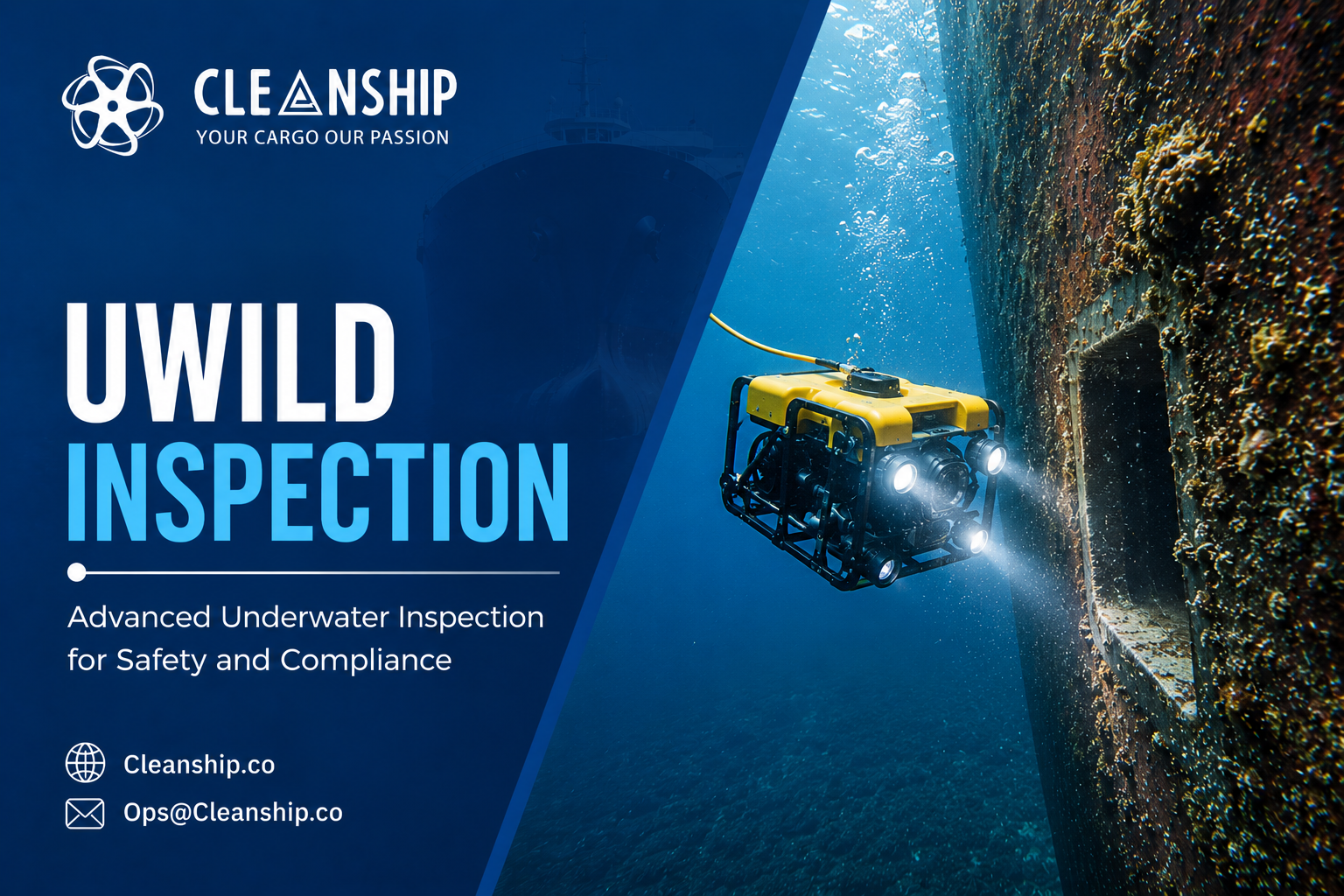
UWILD inspection (Underwater Inspection In Lieu of Drydock) is the classification society-approved mechanism that makes this possible. Conducted by a class society-approved dive company, a UWILD inspection examines the vessel’s underwater structural condition — hull plating, sea connections, rudder, propeller, anodes, bilge keels, and appendages — and produces a report that satisfies the class society’s survey requirements without drydocking.
The operational and financial advantages of UWILD inspection at Indian ports are significant:
- A vessel completing a UWILD inspection at JNPT, Visakhapatnam, or Cochin while loading or discharging cargo has zero off-hire time from the survey itself
- Classification survey requirements that would otherwise require 15–20 days of drydock are satisfied within a single port call
- The cost of a UWILD inspection is a fraction of drydock yard fees, port costs, and off-hire losses associated with a drydock period
- Vessels with clean, regularly inspected hulls—documented by ROV hull inspection and hull fouling inspection records—are the strongest candidates for extended UWILD survey approvals from classification societies
Cleanship’s UWILD inspection operations are conducted by qualified and experienced dive teams aligned with IRS, LR, DNV, BV, and other IACS member society requirements, with complete documentation issued within 24 hours.
Benefit 7: Protecting India’s Coastal Marine Environment Through Responsible Biofouling Removal
Ship hull biofouling removal is an environmental service as well as a commercial one. The biological material removed from vessel hulls during cleaning operations contains living organisms—bacteria, algae larvae, barnacle juveniles, and mussel spat—that represent a genuine risk to the marine environments of India’s ports if released uncontrolled.
The IMO’s biofouling management guidelines identify hull fouling as one of the primary vectors for the transfer of invasive marine species between ocean regions. India’s coastline spans three distinct marine biogeographic zones—the Arabian Sea, the Bay of Bengal, and the Andaman Sea—and the ports connecting these zones (Cochin, Visakhapatnam, Port Blair) are particularly sensitive to invasive species introduction risk.
Cleanship’s MARPOL Annex V-compliant debris containment systems capture biological material removed during ship hull biofouling removal and sea chest cleaning operations, preventing its release into port waters. This debris is then disposed of through approved waste management channels at each port.
This approach protects India’s coastal marine biodiversity, demonstrates the vessel operator’s environmental responsibility to port authorities and classification societies, and provides documented MARPOL compliance evidence that strengthens the vessel’s position in port state control inspections under the Tokyo MOU regime at all 32 Indian port locations.
Port-by-Port Coverage: Ship Hull Biofouling Removal Across India’s 32 Key Ports
Gujarat — West Coast (Northern)
Kandla Port Trust Operating at the head of the Gulf of Kutch, Kandla handles bulk commodities, fertilizers, and petroleum products. The shallow, warm, and productive waters of the Gulf of Kutch create year-round biofouling pressure, with tidal fluctuation exposing the waterline band to cyclical wetting and drying that accelerates both fouling and corrosion at the boot topping. Ship hull biofouling removal at Kandla requires particular attention to waterline band cleaning and sea chest condition given the high nutrient levels in Gulf of Kutch waters.
Mundra Port (APSEZ), India’s largest private port by cargo volume, handles container, bulk, and liquid cargo across a large terminal complex. Located on the southern shore of the Gulf of Kutch, Mundra shares Kandla’s biologically active water conditions. Vessels at Mundra anchorage—which can extend several kilometers offshore in the Gulf—accumulate fouling rapidly. ROV hull inspection is particularly valuable at Mundra for pre-loading and pre-departure condition verification.
Pipavav Port (APM Terminals) A container and bulk terminal in the Saurashtra coast, Pipavav is exposed to seasonal Arabian Sea weather that affects dive operations during the southwest monsoon. Post-monsoon (October–February) is peak biofouling season at Pipavav as nutrient-rich monsoon runoff and warm water temperatures create ideal fouling conditions.
Dahej Port A petrochemical and LNG terminal in the Gulf of Khambhat, Dahej operates in some of the most biologically productive estuarine waters on India’s west coast. The Gulf of Khambhat’s tidal currents and high turbidity create complex fouling patterns that require experienced dive teams and ROV hull inspection capability to assess properly.
Hazira Port (SICAL), near Surat at the mouth of the Tapi River, Hazira handles LNG, general cargo, and bulk traffic. Tropical estuarine water conditions and year-round warm temperatures make Hazira one of the more biologically active port environments on the northern Konkan coast, requiring regular ship hull biofouling removal for vessels on regular Hazira calls.
Maharashtra — West Coast (Central)
Mumbai Port (Mumbai Port Trust) India’s premier commercial port and the largest natural harbour on the west coast, Mumbai’s port waters are warm, high-nutrient, and biologically very active year-round. Vessels at the Mumbai anchorage — where waiting times for berth allocation can extend to 7–14 days during peak seasons — accumulate fouling rapidly. The Mumbai port environment is one of the highest biofouling-risk anchorage areas in India, and ship hull biofouling removal before departure from Mumbai is one of the most commercially valuable single maintenance interventions available to operators on Indian coastal trades.
JNPT (Jawaharlal Nehru Port Trust) India’s largest container port, JNPT handles approximately 50% of India’s containerised cargo volume. Berth congestion and anchorage waiting times are systemic at JNPT — vessels at the JNPT anchorage in Mumbai Harbour and Thane Creek routinely wait 5–10 days for berth allocation, accumulating significant fouling in warm estuarine waters. ROV hull inspection at JNPT provides operators with an up-to-date hull condition assessment before the vessel proceeds on its next voyage.
Dighi Port An emerging bulk commodity port in the Raigad district of Maharashtra, Dighi operates in the sheltered waters of Rajpuri Creek — a warm, productive tidal creek environment with characteristically rapid fouling development, particularly during and after the southwest monsoon season.
Goa and Karnataka — West Coast (Southern)
Mormugao Port (Mormugao Port Trust) Goa’s principal port, Mormugao handles iron ore, coal, and general cargo in the warm, clean waters of the Zuari River estuary. The post-monsoon period from October to January is the heaviest fouling season at Mormugao, coinciding with the peak iron ore export season. Ship hull biofouling removal before loading is a commercially sound preparation for vessels departing Mormugao on long ore voyages.
Karwar Port A smaller commercial and naval-adjacent port in northern Karnataka, Karwar operates in clean, warm Arabian Sea waters with good underwater visibility — making it one of the more suitable locations for ROV hull inspection operations on the southern Konkan coast.
New Mangalore Port (New Mangalore Port Trust) A major petroleum and container terminal, New Mangalore handles significant liquid bulk and container traffic. Warm, biologically active coastal waters and a post-monsoon fouling season from October to March create regular biofouling management requirements for vessels on the New Mangalore run.
Belekeri Port A minor iron ore bulk terminal in Karnataka, Belekeri operates in warm tropical coastal waters where fouling conditions are consistent with the wider southern Karnataka coast. Smaller operational scale but the same tropical fouling conditions as larger neighbouring ports.
Kerala — West Coast (Deep South)
Cochin Port (Cochin Port Trust) Kerala’s — and one of India’s — premier deepwater ports, Cochin handles container, cruise, and liquid bulk traffic in the warm, productive waters of the Vembanad Lake estuary and Arabian Sea approaches. The combination of warm sea surface temperatures, high biological productivity in Kerala backwater-influenced harbour waters, and significant anchorage waiting times makes Cochin one of the highest biofouling-risk port environments on India’s west coast.
Vizhinjam International Seaport India’s first dedicated transshipment container port, Vizhinjam near Thiruvananthapuram is now operational as a deepwater hub. Located on the open Arabian Sea, Vizhinjam’s deep-water location exposes vessels to open-ocean warm Indian Ocean fouling conditions. As a new port without an established maintenance service ecosystem, Cleanship’s mobile dive and ROV capabilities are particularly well-positioned to serve vessels at Vizhinjam.
Kollam Port A smaller cargo and fishing port on the Kerala coast, Kollam handles coastal trade in warm tropical coastal waters. Regular ship hull biofouling removal is relevant for coastal trading vessels making frequent Kollam calls during the non-monsoon trading season.
Tamil Nadu — East Coast (Southern)
Chennai Port (Chennai Port Trust) The dominant commercial port on the Coromandel Coast, Chennai handles container, vehicle, and general cargo in the warm, open waters of the Bay of Bengal. Year-round warm water temperatures (27–30°C) and a long biologically productive season make Chennai one of the most consistent biofouling-pressure environments on India’s east coast.
Ennore Port (Kamarajar Port) India’s first corporatised port, Kamarajar Port at Ennore handles coal, petroleum, and LNG north of Chennai. Warm northern Chennai coastal waters and exposure to Bay of Bengal monsoon conditions create a high biofouling-pressure environment requiring regular underwater hull cleaning and ship hull biofouling removal for vessels on the Ennore berth rotation.
Kattupalli Port (L&T Shipbuilding) A private container and ship-repair terminal north of Chennai, Kattupalli operates in the same warm Bay of Bengal coastal zone as Chennai and Ennore. Its ship repair capabilities make it a natural location for combined ship hull biofouling removal and ROV hull inspection operations timed to support vessel maintenance schedules.
Tuticorin Port (V.O. Chidambaranar Port Trust) Tamil Nadu’s second major port and the gateway to southern India, Tuticorin operates in the warm, shallow waters of the Gulf of Mannar — one of the richest marine biodiversity zones on India’s east coast and one of the most biologically productive. Year-round warm temperatures in the Palk Strait zone make Tuticorin a high-priority location for regular ship hull biofouling removal.
Nagapattinam Port A minor port in the Cauvery delta region of Tamil Nadu, Nagapattinam handles coastal cargo and fishing trade. Warm shallow coastal waters and seasonal post-monsoon fouling conditions apply. ROV hull inspection is particularly relevant for older vessels on the coastal trade calling at Nagapattinam where drydock access is inconvenient.
Cuddalore Port A petroleum and bulk terminal on the Tamil Nadu Coromandel Coast, Cuddalore operates in warm Bay of Bengal coastal waters with consistent tropical fouling conditions requiring regular biofouling management for resident and regular-call vessels.
Andhra Pradesh — East Coast (Central)
Krishnapatnam Port (KPCL) One of India’s fastest-growing bulk and container ports, Krishnapatnam handles coal, container, and other bulk traffic in warm Bay of Bengal waters. High vessel turnover and warm coastal water temperatures make Krishnapatnam a high-priority location for ship hull biofouling removal and ROV hull inspection services.
Gangavaram Port A deepwater bulk port adjacent to Visakhapatnam, Gangavaram handles coal, iron ore, and fertilisers in warm Bay of Bengal conditions. Its deepwater capability — up to 18 metres — is well-suited to ROV hull inspection of large bulk carriers and ore carriers calling on the Visakhapatnam/Gangavaram berth rotation.
Visakhapatnam Port (Visakhapatnam Port Trust) Andhra Pradesh’s largest port and a major naval and commercial hub, Visakhapatnam operates in warm Bay of Bengal waters with year-round biological activity. Long anchorage waiting periods during peak coal import seasons and the presence of both commercial and naval vessels make Visakhapatnam one of the most important locations for Cleanship’s ship hull biofouling removal and ROV hull inspection services on India’s east coast.
Kakinada Port (Kakinada Seaports Limited) An oil, gas, and fertiliser terminal on the Krishna-Godavari delta coast, Kakinada operates in warm, nutrient-rich delta coastal waters with high biological productivity — a fast-fouling environment requiring attentive sea chest cleaning and regular biofouling removal for vessels on regular Kakinada calls.
Machilipatnam Port A smaller coastal trade port in the Krishna delta zone of Andhra Pradesh, Machilipatnam operates in warm tropical coastal conditions with standard east coast India fouling requirements. Its developing port status makes ROV hull inspection a valuable condition monitoring tool for operators using this port.
Odisha — East Coast (Northern)
Paradip Port (Paradip Port Trust) Odisha’s major commercial port, Paradip handles iron ore, coal, and petroleum in warm Bay of Bengal coastal waters subject to heavy post-monsoon fouling accumulation. Paradip is one of the ports where monsoon-season anchorage waiting times most seriously amplify biofouling accumulation, making pre-departure ship hull biofouling removal a high-value maintenance intervention.
Dhamra Port (Adani Ports) A deepwater private port in northern Odisha, Dhamra handles bulk commodities in open Bay of Bengal conditions. Its deepwater infrastructure — up to 18.5 metres — handles large bulk carriers where the scale of biofouling accumulation between cleaning intervals is proportionately significant. ROV hull inspection at Dhamra is well-suited to the large-vessel traffic calling at this terminal.
Gopalpur Port A bulk commodity terminal on the southern Odisha coast, Gopalpur operates in open Bay of Bengal coastal conditions with standard tropical fouling requirements. Vessels on seasonal bulk trades through Gopalpur benefit from biofouling removal before long ocean legs departing this terminal.
West Bengal — East Coast (Far North)
Haldia Dock Complex (Syama Prasad Mookerjee Port) Located on the Hooghly River 60 kilometres from the sea, Haldia operates in tidal river conditions quite different from open-coast ports. The Hooghly River carries high sediment loads that reduce underwater visibility and create complex fouling conditions — high turbidity waters combined with warm temperatures and significant organic matter produce aggressive biofouling on vessel hulls at Haldia berths and anchorages. Sea chest cleaning at Haldia requires particular attention due to sediment and biological matter in the cooling water intake.
Kolkata (Syama Prasad Mookerjee Port) India’s historic gateway port, Kolkata operates deep in the Hooghly River system, 203 kilometres from the sea. Tidal river conditions, high turbidity, and organic-rich water create a distinctive fouling environment at Kolkata. For older vessels that call at Kolkata regularly, ROV hull inspection and UWILD inspection support are important tools for maintaining class certification without expensive voyages to drydock facilities.
Island Territory
Port Blair (Andaman and Nicobar Port) The gateway port to the Andaman and Nicobar Islands, Port Blair operates in the warm, clear, biologically rich waters of the Andaman Sea — one of the most biodiverse marine environments in the Indian Ocean region. The combination of high water temperature (28–30°C year-round), exceptional water clarity, and rich tropical marine biodiversity makes the Andaman Sea one of the most biofouling-aggressive environments in India’s entire port network. For vessels based at Port Blair or making regular calls, the remoteness of the location from mainland drydock facilities makes in-water ship hull biofouling removal and ROV hull inspection especially valuable.
In addition, these services allow operators to address maintenance requirements without undertaking lengthy voyages to mainland shipyards. Moreover, in-water interventions can be scheduled more flexibly around operational commitments. Furthermore, vessel owners can reduce the logistical challenges associated with drydock planning and transit. At the same time, ROV inspections provide detailed condition data while the vessel remains in service.
Additionally, underwater cleaning helps maintain hull performance and operational efficiency between drydock periods. Besides that, early identification of potential issues enables more proactive maintenance planning. Likewise, technical teams can assess hull condition and fouling levels without disrupting commercial schedules. Similarly, regular inspections help monitor coating performance and structural integrity over time.
As a result, operators gain timely information that supports better decision-making and asset management. Consequently, maintenance activities can be prioritized more effectively and completed with fewer operational disruptions. For this reason, in-water ship hull biofouling removal and ROV inspections are particularly beneficial for vessels operating in remote regions. Meanwhile, these services help avoid the significant costs associated with unnecessary drydock voyages. Subsequently, vessel operators can allocate resources more efficiently while maintaining compliance and performance standards.
Ultimately, the combination of inspection and cleaning services enhances operational reliability and fleet efficiency. Therefore, these solutions help avoid the cost and delay of a mainland drydock voyage for condition assessment and routine maintenance, making them especially valuable for vessels operating from Port Blair.
How Biofouling Develops Differently at Each Indian Port Region
Understanding the regional variation in biofouling patterns across India’s coastline helps operators set appropriate cleaning intervals and inspection schedules.
| Region | Ports | Dominant Fouling Organisms | Peak Fouling Season | Recommended Cleaning Interval |
|---|---|---|---|---|
| Gujarat (Gulf of Kutch / Khambhat) | Kandla, Mundra, Pipavav, Dahej, Hazira | Barnacles (acorn and stalked), encrusting bryozoans, tubeworms | October–March (post-monsoon) | Every 3–4 months |
| Maharashtra (Arabian Sea coast) | Mumbai, JNPT, Dighi | Dense barnacle communities, mussel colonies, heavy algal weed | Year-round; peaks October–April | Every 2–3 months (JNPT anchorage) |
| Goa / Karnataka | Mormugao, Karwar, New Mangalore, Belekeri | Barnacles, encrusting algae, hydroids | October–February (post-monsoon) | Every 3–4 months |
| Kerala | Cochin, Vizhinjam, Kollam | Barnacles, mussels, encrusting algae, sea squirts | Year-round; peaks November–April | Every 3 months |
| Tamil Nadu | Chennai, Ennore, Kattupalli, Tuticorin, Nagapattinam, Cuddalore | Barnacles, tube worms, encrusting bryozoans, macro-algae | Year-round; peaks November–March | Every 3–4 months |
| Andhra Pradesh | Krishnapatnam, Gangavaram, Visakhapatnam, Kakinada, Machilipatnam | Barnacles, mussels, hydroids, heavy weed growth | October–March (post-monsoon Bay of Bengal) | Every 3–4 months |
| Odisha | Paradip, Dhamra, Gopalpur | Barnacles, mussels, heavy post-monsoon weed | October–April | Every 3–4 months |
| West Bengal (Hooghly River) | Haldia, Kolkata | Tidal river fouling — barnacles at LWM, slime and biofilm in freshwater zones | Year-round estuarine fouling | Every 4–5 months |
| Andaman Islands | Port Blair | Tropical coral reef associated fouling — rapid, diverse, and extremely aggressive | Year-round; no meaningful seasonal variation | Every 2–3 months |
Cleanship’s Ship Hull Biofouling Removal Process: Step by Step
Step 1 — Pre-Operation Planning and Coordination Cleanship’s operations team reviews the vessel’s antifouling coating specification, previous cleaning records, classification society requirements, and the specific port authority permissions required at the relevant Indian port. Coordination is made with the vessel’s chief officer and chief engineer regarding sea chest valve configuration, engine room systems status, and dive access arrangements.
Step 2 — Pre-Clean ROV Hull Inspection Pass Before any cleaning begins, Cleanship’s ROV conducts a systematic pre-clean inspection pass of the full hull. The ROV documents fouling condition by area and type, records any visible coating damage or structural anomalies, and produces the pre-clean condition record that provides the baseline for post-clean comparison.
Step 3 — Ship Hull Biofouling Removal The cleaning team conducts systematic hull cleaning from stem to stern, deploying the appropriate cleaning method for the vessel’s coating type and fouling severity. The sequence covers the waterline band and boot topping, ship’s sides, flat bottom, bilge keels, rudder, stern frame niche areas, and sea chests. MARPOL-compliant debris containment equipment captures biological residues throughout.
Step 4 — Sea Chest Cleaning Sea chests are cleaned individually, with grating free area fully restored and MARPOL-compliant debris containment applied to all removed biological material.
Step 5 — Propeller Polishing Propeller blades are polished using underwater polishing tools to restore blade surface finish and hydrodynamic profile. Pre- and post-polish blade condition is recorded photographically.
Step 6 — Post-Clean ROV Hull Inspection and Hull Fouling Inspection Following cleaning, the ROV conducts a full post-clean inspection pass. Coating condition, structural observations, anode wastage, and cleaning completeness are all documented. The hull fouling inspection findings are compiled into a structured report indexed by hull area.
Step 7 — UWILD Inspection (Where Required) Where a classification society UWILD inspection is programmed alongside the biofouling removal operation, the class surveyor’s scope is addressed in the post-clean dive, with all relevant structural, mechanical, and coating findings documented to IACS member society requirements.
Step 8 — Documentation and Reporting A complete post-operation documentation package is issued within 24 hours: pre-clean ROV footage, post-clean ROV footage, hull fouling inspection report, cleaning method statement, MARPOL debris disposal records, propeller polishing record, sea chest cleaning record, anode wastage report, and maintenance recommendations.
ROV Hull Inspection Technology: What the Equipment Does and Why It Matters
Cleanship’s ROV hull inspection systems are purpose-built for commercial vessel underwater inspection in Indian port and anchorage conditions. The key technical features include:
HD Camera Systems High-definition cameras with variable focal length capture hull surface detail at resolutions sufficient for coating condition assessment, corrosion identification, and fouling classification. Video recording is continuous throughout the inspection, producing a permanent timestamped record.
High-Power LED Lighting LED light arrays mounted on the ROV frame provide consistent, shadow-free illumination across the hull surface even in the low-visibility, high-turbidity conditions common at river ports like Haldia and Kolkata and during the southwest monsoon season at west coast ports.
Thruster Positioning System Multiple thrusters maintain the ROV at a consistent stand-off distance from the hull surface, compensating for currents, wave action, and vessel movement. This positioning stability is essential for capturing usable inspection footage in port environments with tidal currents and vessel traffic.
Data Recording and Reporting Integration All ROV footage is recorded with timestamp, depth, and positional data overlaid, enabling direct reference back to specific hull locations when reviewing footage. Post-inspection, the footage is edited into a structured report organised by hull area and cross-referenced to any findings noted in the hull fouling inspection written report.
Underwater Hull Cleaning Methods Matched to Indian Water Conditions
Cleanship’s dive teams at Indian ports deploy cleaning methods matched to the vessel’s coating specification and the current fouling condition:
Soft-Brush Rotating Systems (Standard Method) Used for vessels with self-polishing antifouling (SPC) coatings carrying light to moderate biofouling. Soft-brush rotating units remove slime, weed, and early-stage barnacle colonies without abrading the coating polishing surface. This is the standard method for routine maintenance cleaning at 3–4 month intervals on Indian coastal trades.
Medium and Hard-Brush Systems Deployed for vessels with heavier barnacle and mussel fouling — typical of vessels arriving at Visakhapatnam, Paradip, or Mumbai after an extended ocean voyage without cleaning. Medium brush grades break barnacle adhesion while preserving the coating beneath. Hard brush grades are used where coating condition has already deteriorated and coating preservation is no longer the primary concern.
Manual Scraping Tools For particularly aggressive hard fouling — large acorn barnacles, dense mussel colonies, or tube worm reefs — hand scraping tools used by experienced divers address fouling that rotating brush systems cannot effectively remove.
High-Pressure Water Jetting Used for sea chest grating cleaning, spot treatment of heavily fouled niche areas, and vessels with non-antifouling coating systems. Cleanship’s high-pressure water jetting equipment is available at all 32 Indian port locations as a supplement to brush-based cleaning methods.
ROV-Mounted Cleaning Tools For confined spaces (bow thruster tunnels, deep sea chest interiors, rudder niche areas) and for cleaning operations in conditions where diver safety is a concern, ROV-mounted brush and jetting tools extend the cleaning capability beyond diver reach.
How CII Ratings Are Directly Affected by Ship Hull Biofouling
The IMO’s Carbon Intensity Indicator (CII) framework — mandatory for vessels of 5,000 GT and above since January 2023 — rates vessels from A (best) to E (worst) based on their carbon intensity per tonne-mile of cargo transport. Vessels rated D or E face escalating regulatory consequences, including potential operational restrictions.
The connection between ship hull biofouling and CII ratings is direct and measurable:
Biofouling increases fuel consumption per tonne-mile. More fuel per tonne-mile means higher CO₂ per tonne-mile. Higher CO₂ per tonne-mile worsens the CII rating.
For a vessel on the cusp of a CII rating category boundary — say, rated C and at risk of sliding to D — the fuel consumption increase from a single fouling cycle unmanaged through an Indian coastal trading season can be the difference between maintaining an acceptable rating and falling into the D or E band that triggers regulatory intervention.
Regular ship hull biofouling removal is therefore not just a maintenance service under the CII framework — it is a CII compliance strategy. Operators who document their biofouling removal programme as part of their Ship Energy Efficiency Management Plan (SEEMP) are demonstrating the active energy management that the IMO’s regulatory framework expects.
Cleanship’s post-operation reports are structured to support SEEMP documentation, providing the cleaning dates, hull condition assessments, and fuel efficiency improvement estimates that technical superintendents need for CII compliance reporting.
Documentation, Compliance, and Reporting Workflow
Every ship hull biofouling removal and ROV hull inspection operation by Cleanship at Indian ports produces a complete documentation package:
- Pre-clean ROV hull inspection video recording (organised by hull section)
- Pre-clean fouling condition photographs (indexed by hull area)
- Cleaning method statement (aligned with local port authority and MARPOL requirements)
- MARPOL Annex V-compliant debris disposal records
- Post-clean ROV hull inspection video recording
- Post-clean hull condition photographs
- Hull fouling inspection report (fouling rating by area; IMO biofouling categories)
- Coating condition assessment report (erosion rate, breakdown areas, maintenance recommendations)
- Sea chest cleaning completion record (grating free area pre- and post-clean)
- Propeller polishing completion record (blade condition pre- and post-polish)
- Anode wastage record (percentage remaining by anode location)
- UWILD inspection findings report (where class survey scope included; formatted for IACS member society submission)
- Maintenance recommendations (cleaning interval, structural monitoring, drydock timing)
- CII documentation support section (hull performance baseline for SEEMP recording)
All documentation is delivered within 24 hours of operation completion and formatted for submission to DGS, Tokyo MOU port state control, IRS or other IACS member classification societies, charterer vetting systems, and vessel planned maintenance system software.
Future of Ship Hull Biofouling Removal and ROV Hull Inspection in India
Maritime India Vision 2030 and Hull Efficiency India’s Maritime Vision 2030 programme targets a doubling of India’s port capacity and a significant increase in the share of coastal shipping in domestic freight movement. As India’s coastal fleet grows, the demand for professional ship hull biofouling removal and ROV hull inspection services at Indian ports will grow with it.
CII Compliance Driving Maintenance Discipline The IMO’s CII framework, now in its second year of mandatory implementation, is creating commercial pressure on vessel operators to demonstrate energy efficiency management. Hull fouling management is a visible and measurable component of that management, and operators who can document regular biofouling removal will have an advantage in charter party negotiations and port state control interactions.
AI-Assisted Fouling Classification Emerging ROV inspection platforms are incorporating artificial intelligence-based fouling classification systems that can automatically identify, classify, and map biofouling communities from camera footage, producing standardised fouling rating reports with reduced manual analysis time. Cleanship is actively evaluating these technologies for integration into its Indian port inspection operations.
Robotic Hull Cleaning Systems Autonomous and semi-autonomous hull cleaning robots — crawler-mounted brush systems guided by hull-referenced positioning systems — are entering commercial service at high-traffic ports. These systems can operate continuously without diver deployment, making them well-suited to the high-frequency cleaning requirements of vessels at busy Indian anchorages like JNPT, Mumbai, and Visakhapatnam.
Tighter Biosecurity Legislation The IMO’s updated biofouling management guidelines (MEPC.378(80)) and emerging national biosecurity frameworks in India are expected to progressively formalise requirements around biofouling management documentation. Operators who have established regular ship hull biofouling removal and ROV hull inspection programmes now will be ahead of these regulatory developments.
Key Takeaways for Fleet Managers and Ship Operators
- Ship hull biofouling removal is the highest-return maintenance intervention available to Indian coastal fleet operators — fuel savings consistently recover the cleaning cost within 2–3 voyages
- ROV hull inspection provides condition visibility that no other method can match in Indian port conditions — particularly during monsoon season and at river ports like Haldia and Kolkata
- Hull fouling inspection combined with biofouling removal creates the condition data cycle that enables intelligent, proactive hull maintenance rather than reactive emergency responses
- Sea chest cleaning is a non-negotiable component of every complete biofouling removal programme — sea chest fouling is the most direct route from hull maintenance neglect to main engine failure
- Propeller polishing combined with hull cleaning recovers the full propulsion system efficiency that biofouling has degraded — addressing drag and thrust losses together
- UWILD inspection at Indian ports eliminates the need for drydock for condition surveys — preserving the commercial schedule that Indian coastal operations depend on
- CII compliance is directly linked to hull fouling management — regular biofouling removal is now both a maintenance service and an IMO regulatory compliance tool
- Cleanship operates 24/7 at all 32 Indian major ports — from Kandla and Mundra in Gujarat to Port Blair in the Andaman Islands — with complete documentation delivered within 24 hours
Conclusion
Ship hull biofouling removal and ROV hull inspection are no longer optional programmes for Indian coastal fleet operators. They are essential operational disciplines demanded by India’s biological environment, required by India’s regulatory framework, and justified by the clear financial returns they deliver on every Indian coastal voyage.
The warm, productive waters of India’s 7,516-kilometre coastline — from the Gulf of Kutch to the Hooghly delta, from the Kerala backwaters to the Andaman Sea — create some of the world’s most demanding biofouling conditions for commercial vessels. A vessel trading between India’s 32 major ports without a structured ship hull biofouling removal programme is paying a fuel penalty, accumulating a compliance debt, and shortening the service life of its antifouling coating — all simultaneously, and all unnecessarily.
Professional ship hull biofouling removal by Cleanship’s certified dive teams restores hull hydrodynamic performance, recovers fuel efficiency, extends antifouling coating service life, and protects the marine environment through MARPOL-compliant debris containment. ROV hull inspection combined with hull fouling inspection gives technical superintendents and fleet managers the detailed, documented condition picture they need to make intelligent decisions about cleaning intervals, drydock timing, and CII management — without the cost of taking the vessel out of service.
Sea chest cleaning protects the main engine cooling system from the most common cause of operational cooling failures in Indian waters. Propeller polishing completes the propulsion efficiency recovery that hull cleaning alone cannot achieve. UWILD inspection at Indian ports keeps vessels in class on schedule without drydock disruption. And complete documentation — delivered within 24 hours of every operation — supports DGS compliance, Tokyo MOU port state control, IRS and international class society requirements, and charterer vetting processes at all 32 of India’s major commercial ports.
Whether your vessel is loading at Kandla, discharging at Visakhapatnam, waiting at JNPT anchorage, or operating between Port Blair and the mainland, Cleanship is ready to mobilise — 24 hours a day, 7 days a week — to deliver ship hull biofouling removal and ROV hull inspection services that protect your vessel, your schedule, and your commercial margins.
FAQs
Q1. What is ship hull biofouling removal and why does it matter for vessels on Indian coastal trades? Ship hull biofouling removal is the professional underwater cleaning of a vessel’s submerged hull surfaces to eliminate all biological fouling — from the initial slime layer to established barnacle, mussel, and tube worm communities. It matters particularly for Indian coastal trades because India’s warm, high-nutrient coastal waters are among the most biologically aggressive in the world. Biofouling accumulates faster in Indian waters than in most other global trading regions, and the fuel, compliance, and mechanical cost consequences of unmanaged fouling on Indian routes are proportionately severe.
Q2. What is an ROV hull inspection and how is it different from a diver inspection? An ROV hull inspection uses a remotely operated underwater vehicle equipped with HD cameras, lights, and thrusters to examine a vessel’s submerged hull from the surface — without requiring divers to enter the water. Compared to diver inspection, ROV hull inspection provides better performance in low-visibility conditions (monsoon season), access to confined niche areas (sea chests, bow thruster tunnels) that divers cannot safely enter, continuous HD video recording of the full inspection, and the ability to operate without interrupting the vessel’s schedule. For condition assessment and documentation, ROV hull inspection provides a more complete and permanently recorded result than a diver visual survey alone.
Q3. How often should ship hull biofouling removal be carried out at Indian ports? In India’s tropical coastal water conditions, biofouling removal every 3–4 months is recommended for vessels with active self-polishing antifouling coatings on standard Indian coastal routes. Vessels with long anchorage waiting times at JNPT, Mumbai, or Haldia — or vessels based at Port Blair in the Andaman Sea — may require cleaning every 2–3 months. Cleanship will recommend a cleaning interval based on the vessel’s trading pattern, antifouling coating specification, and the condition findings from hull fouling inspection.
Q4. Does ship hull biofouling removal damage the antifouling coating? When performed correctly using calibrated soft-brush rotating systems by trained divers, ship hull biofouling removal does not damage self-polishing antifouling coatings. Cleanship’s dive teams are trained in coating-sensitive cleaning methods and deploy the appropriate brush grade for each coating system. Pre-clean and post-clean coating condition is documented photographically and assessed in the hull fouling inspection report.
Q5. Can Cleanship conduct ROV hull inspection and UWILD inspection at remote Indian ports such as Port Blair, Dhamra, and Belekeri? Yes. Cleanship’s mobile ROV hull inspection and dive team capabilities are deployable at all 32 Indian major port locations, including island ports such as Port Blair and smaller ports such as Belekeri and Dhamra where permanent inspection infrastructure is limited. Port-specific authority permissions and access logistics are managed by Cleanship’s operations team as part of pre-operation planning.
Q6. What is a hull fouling inspection and is it included in every biofouling removal operation? A hull fouling inspection is the structured assessment of biofouling type, severity, and distribution across the vessel’s hull, along with coating condition, structural observations, and maintenance recommendations. Cleanship includes hull fouling inspection as a standard component of every ship hull biofouling removal operation — using both pre-clean and post-clean ROV hull inspection passes to document the starting condition and the post-clean result. The hull fouling inspection report is issued as part of the standard post-operation documentation package.
Q7. How does Cleanship’s work comply with MARPOL during biofouling removal at Indian ports? MARPOL Annex V prohibits the uncontrolled discharge of biological cleaning residues, paint particles, and contaminated water into port waters. Cleanship deploys MARPOL-compliant debris containment systems during every ship hull biofouling removal operation — capturing biological material removed from the hull and sea chests and disposing of it through approved waste management channels at each Indian port. MARPOL compliance documentation is included in the standard post-operation report issued to the vessel’s master.
Q8. Can ship hull biofouling removal improve a vessel’s CII rating? Yes — directly and measurably. The IMO’s CII framework rates vessels on their carbon intensity (CO₂ per tonne-mile). A fouled hull burns more fuel per tonne-mile, worsening the CII rating. Professional ship hull biofouling removal reduces fuel consumption, lowering CO₂ per tonne-mile and improving the CII rating. For vessels on the boundary between CII rating categories, a single biofouling removal operation can shift the vessel from a D or E rating to a C or better. Cleanship’s post-operation reports include fuel efficiency improvement documentation structured to support SEEMP records under the CII compliance framework.