Why Marine Growth Removal Is India’s Most Urgent Underwater Hull Challenge
India has the world’s seventh-longest coastline — 7,516 kilometres stretching from the Rann of Kutch in Gujarat to the Sundarbans delta in West Bengal, with the entire western Malabar coast, the Konkan, and the eastern Coromandel coast in between. Along this coastline, 32 major commercial ports handle over 1.5 billion tonnes of cargo annually. Every vessel calling at these ports operates in water conditions that make marine growth removal one of the most commercially and technically important maintenance services in Indian shipping.
Here is the problem in simple terms. India’s coastal waters are warm, nutrient-rich, and biologically aggressive for most of the year. A vessel arriving at Visakhapatnam, Cochin, or Chennai with a clean antifouling surface can develop visible slime within two weeks. Hard fouling—barnacles, mussels, tube worms—can establish themselves within six to eight weeks in peak monsoon conditions. Each layer of marine growth increases the hydrodynamic drag on the hull, forcing the main engine to work harder and burn more fuel to maintain the same speed.
The second challenge is condition visibility. Unlike hull fouling in drydock, which is examined under bright lights with the vessel out of the water, underwater fouling on an operational vessel is largely invisible to the ship’s managers. A professional UWILD Inspection — Underwater Inspection In Lieu of Drydock — is the industry-standard method for bringing that underwater condition data to the surface, combining visual examination, HD-CCTV documentation, and underwater video survey into a structured report that satisfies both the shipowner’s commercial needs and the classification society’s survey requirements.
At Cleanship Marine Services, we provide professional marine growth removal and UWILD inspection services at all 32 of India’s major commercial ports—from Kandla and Mundra in Gujarat to Kolkata and Haldia in West Bengal, from Port Blair in the Andaman Islands to Paradip and Dhamra in Odisha. This guide explains why these services matter, what they involve, and how they protect your vessel’s performance, compliance, and commercial standing.
India’s Coastline: A Perfect Storm for Ship Hull Biofouling
Understanding why marine growth removal is so critical in India requires understanding what Indian coastal waters do to a ship’s hull. In addition, the warm temperatures and nutrient-rich conditions found in many Indian ports encourage rapid marine organism growth.
Moreover, algae, barnacles, mussels, and other fouling organisms can accumulate on hull surfaces much faster than many vessel operators expect. Furthermore, this buildup increases hull roughness and creates additional resistance in the water. As a result, vessels often experience higher fuel consumption and reduced operational efficiency.
Additionally, prolonged fouling can place extra strain on propulsion systems and other critical components. At the same time, marine growth can contribute to the transfer of invasive aquatic species between ports and regions. Besides that, heavily fouled hulls may make regulatory compliance and inspection processes more challenging. Consequently, regular marine growth removal becomes essential for maintaining vessel performance, fuel efficiency, and environmental responsibility. Therefore, understanding the effects of Indian coastal waters highlights the importance of proactive hull cleaning and fouling management programs.
Water Temperature
Sea surface temperatures along India’s west coast range from 26°C to 32°C for eight to nine months of the year. Along the east coast — from Kakinada and Krishnapatnam through Chennai and Tuticorin—temperatures remain above 28°C year-round in open anchorage areas. At these temperatures, biofouling organisms complete their larval settlement and early growth phases in days rather than weeks. In addition, warm water conditions accelerate the biological processes that support rapid colonization of submerged surfaces. Moreover, nutrient-rich coastal environments provide ideal conditions for marine organisms to thrive.
Furthermore, algae, barnacles, and other fouling species can establish themselves quickly once they attach to a vessel’s hull. At the same time, the longer a vessel remains untreated, the more extensive the fouling buildup can become. Additionally, early-stage growth often develops into dense marine accumulation if preventive measures are not implemented. As a result, hull roughness increases and vessel performance can decline.
Consequently, operators may experience higher fuel consumption and reduced operational efficiency. Besides that, increased fouling can lead to more frequent maintenance requirements and cleaning interventions. Therefore, understanding the rapid growth cycle of biofouling organisms highlights the importance of timely hull inspection and marine growth removal.
In contrast, European waters where many antifouling paint specifications are developed and tested rarely exceed 18–20°C. Consequently, performance expectations established under these cooler conditions may not always translate directly to tropical operating environments.
Moreover, lower water temperatures generally slow the growth and settlement rates of many fouling organisms. By comparison, Indian coastal waters provide a far more favorable environment for rapid biofouling development. Furthermore, warmer temperatures and higher biological activity can place greater demands on antifouling coatings.
As a result, paints designed to a European performance standard can underperform significantly in Indian coastal conditions. Additionally, coating effectiveness may decline faster than anticipated when exposed to these more aggressive fouling pressures. Likewise, vessels operating in Indian waters may require more frequent monitoring and maintenance interventions. At the same time, operators must account for local environmental conditions when planning hull management strategies. Therefore, vessels may reach heavy fouling states faster than their maintenance schedule anticipates. Ultimately, adapting maintenance programs to regional operating conditions is essential for preserving vessel efficiency and coating performance. For this reason, many operators implement more proactive inspection and cleaning schedules in tropical waters.
Nutrient-Rich Coastal Waters
The Arabian Sea along the Gujarat and Maharashtra coast, and the Bay of Bengal along the Odisha and West Bengal coast, experience seasonal upwelling events that bring nutrient-rich deep water to the surface. During and after the southwest monsoon — June to September — coastal waters around Mumbai, JNPT, Mormugao, Cochin, and New Mangalore are particularly rich in the plankton and organic matter that fuel rapid biofouling community development.
Port Anchorage Waiting Times
Marine growth removal before departure from anchorage is one of the most cost-effective interventions available to Indian fleet operators. In addition, it helps restore vessel efficiency before the next voyage begins. Moreover, removing fouling reduces hydrodynamic drag and improves overall vessel performance. Furthermore, cleaner hull surfaces contribute to lower fuel consumption and reduced operating costs.
At the same time, the intervention can help minimize the risk of transporting invasive marine species between ports. Additionally, improved hull condition supports better speed maintenance and voyage planning. Besides that, early removal of marine growth helps prevent heavier fouling from becoming more difficult and expensive to address later. Likewise, regular cleaning can extend the effectiveness of antifouling coatings. Similarly, operators can reduce the likelihood of performance-related maintenance issues during future operations.
As a result, vessels remain more efficient, reliable, and environmentally responsible. Consequently, fleet operators can achieve measurable operational and financial benefits. For this reason, proactive hull maintenance is often far more economical than waiting for severe fouling to develop. Ultimately, timely marine growth removal supports both short-term performance gains and long-term asset preservation. Therefore, it remains one of the most practical and valuable maintenance measures available to vessels operating in Indian waters.
Monsoon Conditions and Reduced Visibility
The southwest monsoon (June–September) reduces underwater visibility significantly at ports on India’s west coast — Cochin, New Mangalore, Mormugao, Hazira. This is not a reason to postpone marine growth removal; it is a reason to deploy experienced dive teams equipped for low-visibility operations and to schedule ROV Hull Inspection and Underwater Video Survey operations outside peak monsoon months where possible.
What Is Marine Growth Removal? A Clear Technical Explanation
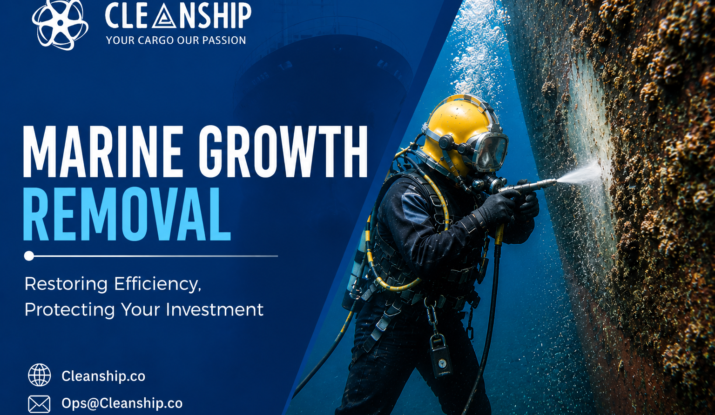
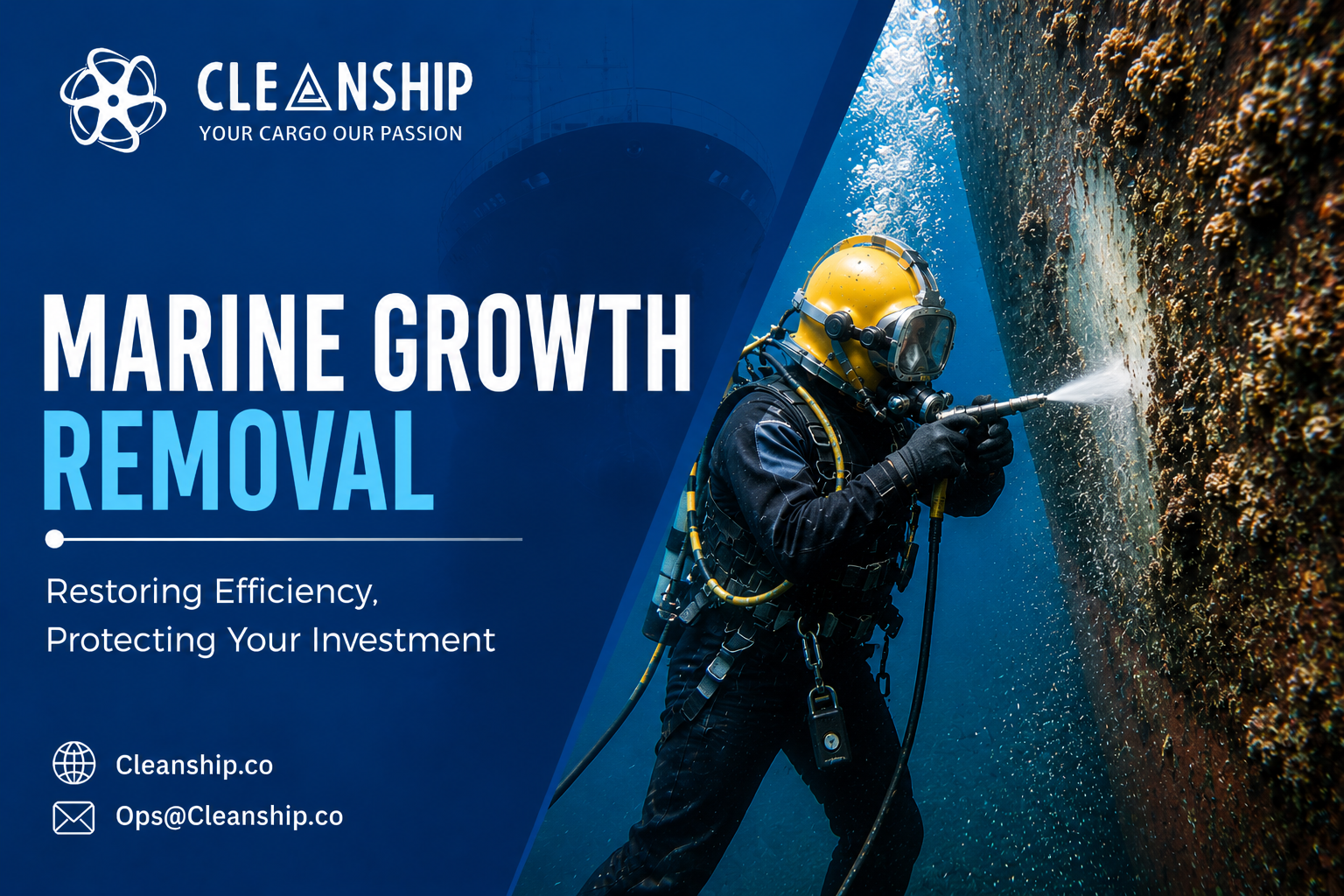
Marine growth removal is the professional underwater cleaning of a vessel’s submerged surfaces to eliminate biofouling—the community of living organisms that colonize ship hulls in seawater. It is performed by trained commercial divers or remotely operated vehicles (ROVs) while the vessel floats in the harbor or at anchor, without the need for drydocking.
In addition, this approach allows maintenance activities to be carried out without interrupting normal vessel operations for extended periods. Moreover, underwater service methods help reduce the costs and logistical challenges associated with drydock scheduling.
Furthermore, commercial divers and ROVs can access critical underwater areas efficiently and safely. At the same time, vessel operators benefit from greater flexibility when planning maintenance work. Additionally, inspections and cleaning tasks can often be completed within a shorter timeframe. Besides that, avoiding drydock visits helps minimize operational downtime and revenue loss. Likewise, underwater maintenance enables operators to address issues before they develop into larger problems. Similarly, condition assessments can be conducted during the same operation to improve maintenance planning. As a result, vessel performance and asset reliability can be maintained more effectively. Consequently, operators gain valuable operational and cost-saving advantages. For this reason, in-water maintenance solutions have become increasingly popular across the maritime industry. Ultimately, they provide a practical and efficient alternative to traditional drydock-based interventions. Therefore, performing these services while the vessel remains afloat delivers both convenience and operational efficiency.
The organisms targeted in marine growth removal fall into two categories:
Micro-fouling (slime layer) The first stage of biofouling is the formation of a microbial biofilm—a thin, slimy layer of bacteria and diatoms that develops within hours of a clean surface being immersed in seawater. This layer is invisible to the naked eye but increases hull roughness measurably. It is also the surface onto which all subsequent macro-fouling organisms settle.
Macro-fouling (hard and soft fouling) Once the slime layer is established, larger organisms settle on it. These include:
- Barnacles (acorn and stalked) — among the most widespread hard foulers in Indian waters
- Mussels — particularly aggressive in the nutrient-rich waters of the Gulf of Kutch (near Kandla and Mundra) and the Bay of Bengal
- Tube worms—create hard calcium carbonate tubes that are difficult to remove without aggressive tools
- Hydroids and bryozoans — soft fouling that can reach significant thickness in protected niche areas
- Macro-algae (weed)—particularly common in shallower anchorage areas off Haldia, Dighi, and Gopalpur
Marine growth removal addresses all of these categories, from slime layer disruption to hard barnacle and mussel removal, using methods calibrated to the vessel’s antifouling coating type and the current fouling severity.
What Is a UWILD Inspection? A Clear Technical Explanation
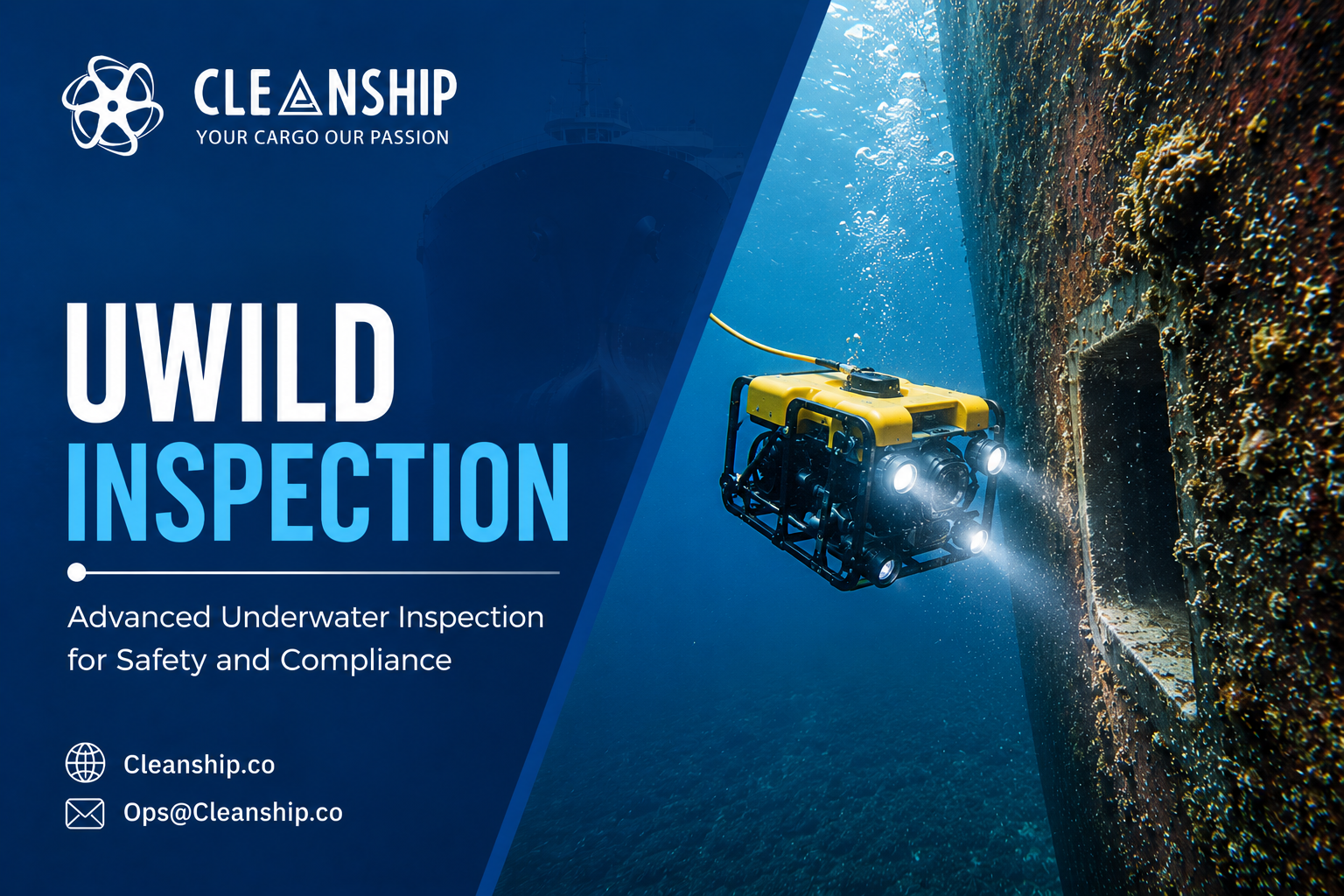
UWILD stands for Underwater Inspection In Lieu of Drydock. It is a formal classification society survey conducted underwater, by trained and approved divers or ROV operators, that substitutes for or supplements a drydock examination of the vessel’s underwater hull, appendages, and sea connections.
The purpose of a UWILD Inspection is to allow a classification society surveyor (or their approved dive company) to examine the condition of the vessel’s underwater structure and confirm that it meets the class society’s requirements for continued certification—without requiring the vessel to be taken out of service for drydock.
A UWILD Inspection typically covers:
- Hull plating — checking for corrosion, pitting, mechanical damage, and coating condition
- Sea valves and sea chests — confirming operability and freedom from excessive fouling or corrosion
- Rudder and rudder pintle — checking for mechanical damage, clearance, and corrosion
- Propeller and shaft — examining blade condition, tip clearance, and seal area
- Sacrificial anodes — recording wastage levels and confirming adequate cathodic protection
- Bow thruster tunnels — examining fouling, corrosion, and blade condition
- Bilge keels — checking weld condition and structural integrity
- Underwater paint condition — recording antifouling coating type, condition, erosion, and any breakdown areas
A UWILD Inspection is not the same as a simple dive report. It is a structured, documented survey conducted to classification society requirements (IACS member societies — Lloyd’s Register, DNV, Bureau Veritas, ClassNK, IRS, and others), and the findings are recorded in the vessel’s survey record.
When combined with marine growth removal on the same dive, the operator gets both the cleaning and the condition data in a single mobilization. In addition, this integrated approach streamlines underwater maintenance and inspection activities. Moreover, it reduces the need for separate dive operations and additional vessel scheduling. Furthermore, combining both services helps optimize resource utilization and project planning. At the same time, cleaned surfaces provide clearer visibility for accurate condition assessments.
Additionally, inspectors can identify potential defects, coating issues, or structural concerns more effectively. Besides that, the vessel benefits from improved hydrodynamic performance immediately after cleaning. Likewise, maintenance teams receive valuable condition data that can support future repair and maintenance decisions. As a result, operators save both time and operational costs. Consequently, vessel downtime is minimized while maintenance efficiency is improved. For this reason, many operators prefer integrated cleaning and inspection programs over separate interventions. Therefore, combining marine growth removal and UWILD inspections in a single mobilization delivers greater operational value, efficiency, and insight.
The Full Picture: How Marine Growth Removal and UWILD Inspection Work Together
The most operationally efficient and commercially cost-effective approach to underwater hull management is to combine marine growth removal with a UWILD inspection on the same dive operation.
Here is why these two services are natural partners:
Before the clean, the true condition is hidden. Marine growth on a heavily fouled hull conceals the coating beneath it. An underwater paint condition inspection or structural examination conducted before cleaning produces unreliable results because the diver or ROV cannot see the plating or coating through the fouling.
After the clean, everything is visible. With marine growth removed, the antifouling coating condition, any corrosion pitting, mechanical damage, anode wastage, and structural anomalies are all accessible to camera and diver examination. A thorough UWILD inspection conducted immediately after marine growth removal produces the most accurate and complete condition picture possible.
One mobilisation, two services. Calling divers to the vessel twice—once for cleaning and once for inspection—doubles mobilization costs, doubles vessel disruption, and doubles the coordination burden.
A combined marine growth removal and UWILD inspection program delivers both outcomes in a single operation. In addition, this integrated approach helps vessel operators save valuable time and operational resources. Moreover, conducting both activities simultaneously reduces the need for separate underwater interventions.
Furthermore, it minimizes vessel downtime and helps maintain operational schedules more effectively. At the same time, marine growth removal improves access to critical hull areas that require inspection. Additionally, cleaner surfaces allow inspectors to obtain more accurate assessments of the vessel’s condition. As a result, maintenance decisions can be made with greater confidence and precision. Consequently, operators can address potential issues before they develop into more significant problems. Besides that, combining these services often improves overall project efficiency and coordination. Likewise, it supports compliance with inspection and maintenance requirements while optimizing operational planning. Therefore, a combined marine growth removal and UWILD inspection program provides a practical, cost-effective, and highly efficient solution for vessel maintenance and regulatory compliance.
Cleanship’s standard operational approach at all 32 Indian port locations is to offer marine growth removal and UWILD inspection as an integrated service, with underwater video survey documentation and underwater paint condition inspection included as standard outputs.
Regulatory Framework: India, IMO, and Classification Society Requirements
Directorate General of Shipping (DGS), India
The Directorate General of Shipping is the Indian government authority responsible for maritime administration, vessel certification, and port state control enforcement. DGS implements IMO conventions in Indian law, including MARPOL, SOLAS, and the Ballast Water Management Convention. Under Indian regulations, vessels calling at Indian ports are subject to port state control inspection that may include review of hull maintenance documentation and biofouling management records.
IMO Biofouling Management Guidelines (MEPC.207(62) and MEPC.378(80))
The IMO’s biofouling management guidelines define the framework for managing hull fouling to prevent invasive species transfer. The updated 2023 guidelines (MEPC.378(80)) strengthen requirements around biofouling record books, niche area management (sea chests, bow thruster tunnels, and bilge keels), and documentation of cleaning operations. These guidelines apply to vessels calling at Indian ports just as they apply globally.
MARPOL Convention
MARPOL Annex V governs the management of waste generated during marine growth removal operations. Biological residues, paint particles, and water used during hull cleaning must be handled in compliance with MARPOL requirements. Cleanship’s debris containment systems are designed to meet these requirements at all Indian ports.
Classification Society UWILD Requirements
IACS member classification societies—including the Indian Register of Shipping (IRS), Lloyd’s Register, DNV, Bureau Veritas, and ClassNK—all have formal requirements for UWILD inspections as part of their special survey and continuous survey programs. These requirements specify the scope of examination, the qualifications of the dive company, and the documentation to be produced. Cleanship works with approved surveyors to ensure UWILD inspections meet these requirements at Indian ports.
Ballast Water Management Convention
The Ballast Water Management Convention, in force since 2017, requires vessels to manage their ballast water to prevent invasive species transfer. Hull fouling — including biologically active sea chests — is a parallel pathway for species transfer that is now under increasing regulatory scrutiny. Marine growth removal and sea chest cleaning support a vessel’s overall biosecurity compliance posture.
Benefit 1: Fuel Savings That Pay for Themselves Across Indian Coastal Voyages
The most immediately quantifiable benefit of marine growth removal is the reduction in fuel consumption that follows a successful cleaning operation.
The drag penalty from biofouling is significant and measurable. Industry research and operational data consistently show:
- Light slime fouling (micro-fouling only): 1–5% increase in fuel consumption
- Moderate macro-fouling (barnacles and weed to 5mm thickness): 8–15% fuel consumption increase
- Heavy fouling (barnacles to 20mm+, mussel colonies): 20–40% fuel consumption increase
- Severe fouling with coating breakdown: 40%+ fuel consumption increase
For a vessel operating on the Indian coast — for example, a bulk carrier trading between Kandla, Mumbai, Mormugao, New Mangalore, Cochin, Tuticorin, and Visakhapatnam — the cumulative fuel cost of heavy fouling over a six-month period can represent hundreds of thousands of dollars in additional bunker expenditure. Marine growth removal that restores the hull to near-clean condition pays back its cost in fuel savings within a single round voyage on many Indian coastal routes.
When combined with propeller polishing — which addresses the roughness of propeller blade surfaces independently of hull fouling — the combined fuel consumption improvement is the largest single performance gain available to an operator without major capital investment.
Benefit 2: UWILD Inspection as a Cost-Effective Alternative to Drydock
Drydock is expensive. For a Panamax bulk carrier, a full drydock period — including yard fees, crew costs, off-hire losses, and repairs identified during docking — can cost $500,000 to $1,500,000 depending on vessel condition and repair scope. The vessel is out of service for 15 to 25 days.
A UWILD inspection, conducted by a classification society-approved dive company while the vessel is operational in port, achieves the same objective—confirming the vessel’s structural and mechanical condition for continued class certification—at a fraction of the cost and with minimal off-hire impact.
For vessels operating intensive Indian coastal schedules — short-haul routes between JNPT, Hazira, Dahej, Pipavav, and Mundra in Gujarat, or between Paradip, Dhamra, Haldia, and Kolkata in the east — the ability to complete a classification survey requirement in port without taking the vessel out of service has enormous commercial value.
UWILD inspections are permitted under IACS member society rules as substitutes for certain drydock examinations, subject to satisfactory results. A clean hull is a prerequisite for an effective UWILD inspection—which is precisely why marine growth removal and UWILD inspection are programmed together.
Benefit 3: Protection of Antifouling Coatings in Tropical Indian Waters
Antifouling coatings are the first line of defense against hull biofouling. In Indian conditions — high water temperatures, high biological activity, and long anchorage periods — these coatings work harder than in most other trading regions. Protecting them between drydock intervals is critical to controlling long-term hull maintenance costs.
There are two ways that unmanaged marine growth damages antifouling coatings:
Physical attachment damage. Barnacles attach to hull surfaces by secreting a cement-like protein adhesive at their base. When barnacles are removed using aggressive tools — or allowed to grow until they are removed by friction or abrasion — the adhesive and the barnacle base can pull the antifouling coating away from the underlying primer. This creates bare patches where corrosion begins.
Coating depletion acceleration. Self-polishing antifouling coatings work by a controlled surface erosion mechanism—the coating dissolves slowly in seawater, releasing biocide as it does so. Heavy fouling over the coating surface prevents the coating from polishing at its designed rate, leading to uneven depletion and early exhaustion of the active biocide layer.
Professional marine growth removal using calibrated soft-brush rotating systems removes biological material without damaging the coating beneath. The result is that the antifouling coating continues to perform as designed, and the interval to the next drydock recoating is preserved. For vessels operating out of Port Blair, Vizhinjam, Kollam, or Belekeri—ports where drydock facilities require a voyage to reach—maximizing coating service life has particular value.
Benefit 4: Sea Chest Cleaning—The Critical Niche Area Within Every Marine Growth Removal Programme
Sea chests are the most biologically aggressive niche area on any vessel’s underwater surface. Protected from the antifouling paint’s polishing action and from the turbulence of open water, the sea chest chamber and its grating provide an ideal sheltered habitat for barnacles, mussels, and tube worms.
At Indian ports—particularly in the warm, nutrient-rich waters of the Arabian Sea and Bay of Bengal—sea chest fouling can progress from light growth to complete grating blockage within two to three months.
In addition, elevated water temperatures create ideal conditions for rapid marine organism growth.
Moreover, abundant nutrients in coastal waters support the continuous development of algae, barnacles, mussels, and other fouling species. Furthermore, sheltered sea chest environments provide protection that allows these organisms to establish themselves more easily. At the same time, restricted water flow inside the chamber can accelerate the accumulation process.
Additionally, vessels operating frequently between ports may encounter varying fouling pressures that contribute to faster buildup. Besides that, even moderate fouling can begin to affect seawater intake efficiency and cooling system performance. Likewise, untreated growth can spread across gratings, internal surfaces, and connected components.
As a result, seawater flow may become increasingly restricted over time. Consequently, critical onboard systems that depend on adequate cooling water can face operational challenges. For this reason, regular inspection and preventive maintenance are essential for maintaining system reliability.
Similarly, proactive cleaning schedules help reduce the risk of unexpected blockages and costly downtime. Ultimately, early intervention is far more effective than addressing severe fouling after it has fully developed. Therefore, monitoring and managing sea chest fouling should remain a priority for vessels operating in Indian coastal waters.
A blocked sea chest restricts the cooling water supply to the main engine, raising cooling water temperatures and, in severe cases, triggering engine shutdowns.
Sea chest cleaning as part of every marine growth removal program ensures that:
- Cooling water flow is maintained at the designed volume and pressure
- The sea chest chamber is cleared of biological material that could enter downstream pipework
- MARPOL-compliant debris containment prevents biological material from being released into port waters
- Post-cleaning documentation confirms grating-free area restoration for compliance records
Cleanship includes sea chest cleaning as a standard element of every marine growth removal operation at all 32 Indian ports. It is not an optional add-on—it is a non-negotiable component of a complete underwater hull maintenance programme.
Benefit 5: Propeller Polishing — Completing the Hydrodynamic Picture
A vessel that has undergone professional marine growth removal on its hull is operating at reduced drag.
However, if the propeller blades carry even a light layer of biological growth or surface roughness from corrosion and cavitation, the propulsion system is delivering less than its designed thrust efficiency.
In addition, even a small amount of fouling can significantly disrupt the smooth flow of water across the blade surfaces. Moreover, this disturbance increases hydrodynamic resistance and reduces propulsion effectiveness. Furthermore, corrosion pits and cavitation damage create additional surface irregularities that impair performance.
At the same time, the vessel may require more engine power to maintain the same operating speed. Additionally, increased power demand often results in higher fuel consumption and operating costs. Besides that, reduced propeller efficiency can place extra stress on engines and propulsion components. Likewise, long-term performance losses may contribute to increased maintenance requirements.
As a result, overall vessel efficiency and operational reliability can decline. Consequently, shipping operators may experience reduced profitability and greater environmental impact due to higher emissions. For this reason, routine propeller inspections and maintenance are essential for sustaining optimal performance. Ultimately, timely cleaning and polishing help restore smooth blade surfaces and maximize thrust efficiency. Therefore, addressing biological growth, corrosion, and cavitation at an early stage is critical for maintaining efficient vessel operations.
In addition, even minor surface imperfections can disrupt smooth water flow around the blades. Moreover, this increased resistance forces the propulsion system to work harder to maintain the same speed. Furthermore, reduced propeller efficiency can lead to higher fuel consumption and increased operating costs.
At the same time, engine loads may rise, placing additional stress on critical mechanical components. Additionally, prolonged exposure to fouling and surface damage can accelerate wear on the propulsion system. As a result, vessel performance and overall operational efficiency can decline noticeably. Consequently, shipping operators may experience reduced productivity and higher maintenance requirements. Besides that, inefficient propulsion can contribute to increased emissions and environmental impact. Therefore, regular propeller polishing and maintenance are essential for maximizing thrust efficiency, fuel economy, and vessel performance.
Propeller polishing is the underwater cleaning and surface finishing of the propeller blades to restore their hydrodynamic profile and blade surface finish. Marine growth on propeller blades — even a thin biofilm layer — creates turbulent boundary-layer flow over the blade surface, reducing thrust and increasing fuel consumption. Hard fouling on propeller blades causes uneven loading, increased shaft vibration, and accelerated cavitation damage.
Industry data shows that propeller polishing alone, independent of hull condition, can improve fuel efficiency by 4–8%. Combined with marine growth removal from the hull, the total performance recovery is consistently 12–25% on Indian coastal trades, depending on the starting fouling condition.
For vessels operating on high-frequency coastal routes — Tuticorin to Chennai, Visakhapatnam to Paradip, Kandla to Mumbai — where multiple voyages per month are the norm, the cumulative fuel cost of an unpolished propeller is substantial. Cleanship includes propeller polishing as a standard element of every complete marine growth removal operation.
Benefit 6: Compliance with DG Shipping, Port State Control, and Class Society Requirements
Indian port state control, administered under the authority of the Directorate General of Shipping, follows the Tokyo MOU (Memorandum of Understanding on Port State Control) inspection regime. Under the Tokyo MOU, vessels calling at Indian ports are subject to inspection against SOLAS, MARPOL, ISM, and other convention requirements. Hull maintenance documentation — including biofouling management plans and cleaning records — is an area of increasing inspection focus.
Classification societies conducting UWILD inspections at Indian ports — including the Indian Register of Shipping (IRS), which has a strong presence at Kolkata, Visakhapatnam, Mumbai, and Chennai — require dive companies to meet specific competency and documentation standards. Cleanship’s operational procedures are aligned with these requirements, ensuring that UWILD inspection reports produced by our teams are accepted by IRS and other IACS member societies.
Professional marine growth removal, sea chest cleaning, and UWILD inspection — documented with pre- and post-operation photographs, cleaning method statements, and condition assessments — provide the compliance evidence that protects vessel operators in port state control inspections, charterer vetting processes, and class society interactions at every Indian port.
Benefit 7: ROV Hull Inspection and Underwater Video Survey for Accurate Condition Assessment
Not every underwater condition assessment requires divers in the water. ROV Hull Inspection — using remotely operated vehicles equipped with HD cameras, lights, and positioning systems — is an increasingly important tool for hull condition assessment, particularly in:
- Low-visibility conditions (monsoon season at west coast ports)
- Confined spaces (sea chest interiors, bow thruster tunnels)
- Deep-draught vessels where diver bottom access is restricted
- Pre-cleaning condition recording to document the starting fouling state
Underwater Video Survey produces a permanent visual record of the hull’s condition at the time of inspection. This record serves multiple purposes:
- Supporting UWILD inspection documentation for classification societies
- Providing baseline condition data for planned maintenance system records
- Documenting hull condition for charter party performance disputes
- Recording antifouling coating condition for paint manufacturer warranty purposes
- Creating evidence for insurance purposes in the event of underwater damage claims
Cleanship’s underwater video survey capabilities include HD-CCTV documentation of hull fouling condition, coating state, anode wastage, structural findings, and sea chest condition — all compiled into a structured report indexed by hull area and delivered within 24 hours of the dive operation.
Underwater paint condition inspection is a specific component of the underwater video survey that records the antifouling coating’s erosion rate, any areas of coating breakdown, primer exposure, blistering, or mechanical damage. This information is essential for planning the next drydock antifouling specification and for managing the coating’s performance between docking intervals.
Port-by-Port Coverage: Marine Growth Removal Across India’s 32 Key Ports
Gujarat Ports (West Coast — Northern)
| Port | Key Characteristics | Marine Growth Removal Priority |
|---|---|---|
| Kandla | High cargo volumes; Gujarat Gulf waters warm and productive year-round | High — Gulf of Kutch nutrient-rich conditions drive rapid fouling |
| Mundra | India’s largest private port; heavy bulk and container traffic | High — same Gulf of Kutch fouling conditions as Kandla |
| Pipavav | Container and bulk terminal; exposed anchorage | Medium-High — seasonal fouling peaks post-monsoon |
| Dahej | Petrochemical port; industrial vessel traffic | High — warm industrial harbour waters |
| Hazira | LNG and general cargo; near Surat | High — tropical creek environment; fast fouling development |
Maharashtra Ports (West Coast — Central)
| Port | Key Characteristics | Marine Growth Removal Priority |
|---|---|---|
| Mumbai | India’s premier commercial port; long anchorage waiting times | Critical — long anchorage times in warm, high-nutrient Arabian Sea waters |
| JNPT | India’s largest container port; heavy traffic congestion | Critical — berth waiting times of 5–15 days common; rapid fouling at anchorage |
| Dighi | Emerging bulk port in Raigad district | Medium — newer port with developing fouling history; tropical conditions apply |
Goa and Karnataka Ports (West Coast — Southern)
| Port | Key Characteristics | Marine Growth Removal Priority |
|---|---|---|
| Mormugao | Goa’s main port; iron ore and bulk cargo | High — rich monsoon-influenced waters; seasonal fouling peaks |
| Karwar | Defence and commercial use; picturesque coastal location | Medium — lower traffic but tropical coastal fouling applies |
| New Mangalore | Petroleum and container terminal | High — warm, biologically active western coastal waters |
| Belekeri | Iron ore bulk terminal | Medium-High — moderate traffic but tropical water conditions |
Kerala Ports (West Coast — Deep South)
| Port | Key Characteristics | Marine Growth Removal Priority |
|---|---|---|
| Cochin | Major container and cruise port; large anchorage area | High — warm Kerala backwater-influenced harbour; fast fouling |
| Vizhinjam | India’s new deep-water transshipment port | High — deep-water location but tropical Indian Ocean fouling applies |
| Kollam | Smaller cargo port; coastal trade | Medium — lighter vessel traffic but same tropical fouling conditions |
Tamil Nadu Ports (East Coast — Southern)
| Port | Key Characteristics | Marine Growth Removal Priority |
|---|---|---|
| Chennai | Major container and general cargo hub | High — warm Bay of Bengal waters; year-round fouling |
| Ennore (Kamarajar) | Coal and petroleum terminal | High — industrial port with warm northern Chennai waters |
| Kattupalli | Private container and ship repair port | High — same Chennai coastal zone fouling conditions |
| Tuticorin (V.O. Chidambaranar) | Southern Tamil Nadu’s major port | High — Palk Strait waters warm year-round; fast barnacle settlement |
| Nagapattinam | Fishing and minor cargo; Cauvery delta coast | Medium — shallow coastal location; seasonal fouling peaks |
| Cuddalore | Petrochemical and bulk cargo | Medium-High — warm coastal waters; regular fouling management needed |
Andhra Pradesh Ports (East Coast — Central)
| Port | Key Characteristics | Marine Growth Removal Priority |
|---|---|---|
| Krishnapatnam | Fast-growing bulk and container port | High — Bay of Bengal warm water conditions; high vessel turnover |
| Gangavaram | Deep-water bulk port near Vizag | High — same Visakhapatnam coastal zone; fast fouling |
| Visakhapatnam | Andhra Pradesh’s largest port; naval and commercial | High — warm Bay of Bengal; UWILD inspection frequently required for naval-adjacent vessels |
| Kakinada | Oil and gas terminal | High — warm eastern coastal waters; niche area fouling in sea chests |
| Machilipatnam | Smaller coastal trade port | Medium — developing port with standard tropical fouling conditions |
Odisha Ports (East Coast — Northern)
| Port | Key Characteristics | Marine Growth Removal Priority |
|---|---|---|
| Paradip | Major iron ore and petroleum port | High — Bay of Bengal monsoon conditions drive heavy post-monsoon fouling |
| Dhamra | Private deep-water bulk port | High — exposed Bay of Bengal location; fast fouling accumulation |
| Gopalpur | Bulk terminal; southern Odisha | Medium-High — open coastal location; tropical fouling conditions |
West Bengal Ports (East Coast — Northern)
| Port | Key Characteristics | Marine Growth Removal Priority |
|---|---|---|
| Haldia | Major petroleum and bulk port; tidal river location | High — Hooghly River water conditions with high turbidity; niche area fouling aggressive |
| Kolkata | Historic port; river location limits access | Medium-High — tidal river fouling conditions; UWILD inspection important for older vessels |
Island Port
| Port | Key Characteristics | Marine Growth Removal Priority |
|---|---|---|
| Port Blair | Andaman and Nicobar Islands; tropical island location | Critical — warm, crystal-clear Andaman Sea waters support rapid and aggressive biofouling; remote location makes drydock access expensive, increasing value of in-water marine growth removal and UWILD inspection |
Understanding UWILD Inspection: What the Dive Covers, What the Survey Finds
A professional UWILD inspection at any of the 32 Indian port locations covered by Cleanship follows a structured scope of work aligned with IACS member society requirements. Here is what the inspection covers in detail.
Hull Plating Survey
Divers or ROV equipment systematically examine the hull plating for the following:
- Corrosion and pitting (recording severity and extent)
- Mechanical damage (indentations, cracks, weld failures)
- Wastage at the waterline band and boot topping
- Any evidence of grounding damage
Sea Valve and Sea Chest Survey
All accessible sea valves and sea chest gratings are examined for:
- Operational condition of sea valve covers
- Grating free area (percentage of open area remaining after fouling)
- Corrosion condition of grating and surrounding plating
- Any evidence of electrolytic corrosion between dissimilar metals
Rudder Survey
The rudder is examined for:
- Overall structural condition
- Pintle clearance and bearing condition (where accessible)
- Corrosion at the lower pintle, gudgeon areas, and drain plugs
- Any mechanical damage from contact or heavy weather
Propeller and Shaft Survey
The propeller and visible shaft are examined for:
- Blade condition (erosion, cavitation damage, mechanical damage)
- Blade tip clearance (where accessible)
- Stern tube seal area condition (for evidence of oil leakage)
- Shaft bracket and A-bracket condition (on twin-screw or bracket-supported shafts)
Sacrificial Anode Survey
All accessible sacrificial anodes are recorded for:
- Remaining anode mass (percentage wastage)
- Continuity of attachment to hull plating
- Appropriateness of anode distribution for cathodic protection coverage
Bow Thruster Tunnel Survey
Where fitted, bow thruster tunnels are examined for the following:
- Fouling condition inside the tunnel
- Blade condition of the bow thruster propeller
- Corrosion condition of the tunnel lining
Bilge Keel Survey
Bilge keels are examined along their full length for:
- Weld condition at the attachment to hull plating
- Corrosion and wastage
- Any mechanical damage or deformation
Underwater Paint Condition Inspection
A complete underwater paint condition inspection records:
- Antifouling coating type and condition (polishing rate, erosion, and remaining thickness assessment)
- Any areas of coating breakdown, blistering, or primer exposure
- Paint condition at niche areas (sea chests, rudder lower edge, propeller hub)
- Recommendations for recoating specification and timing
Marine Growth Removal Methods: Choosing the Right Approach for Indian Waters
Not all marine growth removal is the same. The method selected must be matched to the vessel’s antifouling coating type, the current fouling severity, and the port conditions. Cleanship’s operational teams at Indian ports deploy the appropriate method for each situation.
Soft-Brush Rotating Systems
The standard method for light to moderate fouling on self-polishing antifouling (SPC) coatings. Rotating brush systems mounted on diver-operated or ROV equipment remove slime, light weed, and early-stage barnacle colonies without abrading the coating surface. This method is appropriate for routine maintenance cleaning at intervals of 3–6 months in Indian tropical conditions.
Hard-Brush and Scraper Combinations
For vessels with heavy barnacle or mussel fouling — common on vessels arriving at Visakhapatnam, Paradip, or Kolkata after an extended voyage without cleaning — harder brush grades and manual scraping tools are required to break the adhesion of established hard fouling. Care is taken to avoid gouging the coating beneath.
High-Pressure Water Jetting
For vessels with paint systems that are not antifouling (epoxy coatings on permanently moored vessels, coating systems on icebreakers transiting to Indian waters) or for spot treatment of areas where hard fouling has bonded particularly aggressively, high-pressure water jetting removes fouling and any damaged coating simultaneously. This is also used for sea chest cleaning where grating fouling is particularly heavy.
ROV-Assisted Cleaning
In areas of restricted diver access—bow thruster tunnels, deep sea chest interiors, rudder niche areas — ROV-mounted cleaning tools reach surfaces that divers cannot safely access. ROV-assisted cleaning is particularly valuable at deep-draught ports like Vizhinjam, Gangavaram, and Dhamra.
How Cleanship Conducts Marine Growth Removal and UWILD Inspection
Cleanship’s operational workflow at Indian ports is designed to deliver technical quality, classification society compliance, and complete documentation in a single planned mobilization.
Step 1 — Pre-Operation Planning Cleanship’s operations team reviews the vessel’s cleaning history, antifouling coating specification, class society requirements, and port authority documentation requirements before the dive team mobilises. Contact is made with the vessel’s chief officer and chief engineer to coordinate sea chest valve positions and engine room cooling system status.
Step 2 — Pre-Dive Condition Recording Before any cleaning begins, divers conduct a systematic pre-dive visual survey of the hull, recording fouling condition photographically and by underwater video survey. This pre-clean record documents the starting condition for compliance purposes and establishes the baseline against which the post-clean improvement is measured.
Step 3 — Marine Growth Removal Hull cleaning proceeds systematically from stem to stern — waterline band and boot topping, ship’s sides, flat bottom, bilge keels, rudder, propeller, and sea chests. Debris containment equipment is deployed throughout to capture biological material and prevent its release into port waters in compliance with MARPOL Annex V.
Step 4 — Propeller Polishing Following hull cleaning, propeller blades are polished using specialist underwater polishing tools to restore blade surface smoothness and hydrodynamic profile.
Step 5 — UWILD Inspection With the hull cleaned, the UWILD inspection proceeds — divers or ROV equipment systematically examine all survey areas (hull plating, sea chests, rudder, propeller, anodes, bow thruster, bilge keels) with HD-CCTV documentation of all significant findings.
Step 6 — Underwater Paint Condition Inspection Coating condition is assessed and recorded across the full hull, with particular attention to niche areas and any identified deterioration zones.
Step 7 — Post-Operation Reporting A complete post-operation documentation package is issued within 24 hours, including pre- and post-clean photographs, underwater video survey footage, UWILD inspection findings report, coating condition assessment, cleaning method statement, debris disposal confirmation, and maintenance recommendations.
Underwater Paint Condition Inspection: Why Coating Assessment Matters as Much as Cleaning
Marine growth removal without a concurrent underwater paint condition inspection is an incomplete operation. Here is why.
A vessel’s antifouling coating is its primary defence against the biofouling that marine growth removal is designed to address. If the coating is performing well — polishing at the designed rate, releasing biocide evenly, maintaining film integrity — the vessel will re-foul more slowly after cleaning. If the coating is failing — areas of breakdown, depleted biocide reservoir, blistering, or mechanical damage — the vessel will re-foul rapidly regardless of how well the cleaning was conducted.
Without knowing the coating condition, the operator has no basis for:
- Setting an appropriate next cleaning interval (a vessel with a failing coating needs cleaning sooner)
- Planning the next drydock antifouling specification (a failing coating needs replacing, not just refreshing)
- Supporting a paint manufacturer warranty claim (coating condition must be documented when failure is identified)
- Demonstrating to a class surveyor that the hull is properly maintained between drydock intervals
Cleanship’s post-operation reports include a structured underwater paint condition inspection section that records coating type, overall condition rating, erosion rate assessment, and a location map of any identified breakdown areas. This information feeds directly into the vessel’s planned maintenance system and drydock planning process.
Documentation and Compliance Workflow
Every marine growth removal and UWILD inspection operation by Cleanship produces a complete documentation package:
- Pre-dive fouling condition photographs (organised by hull area)
- Underwater video survey recording of pre-clean condition
- Cleaning method statement (aligned with local port authority and MARPOL requirements)
- MARPOL Annex V-compliant debris disposal records
- Post-clean hull condition photographs
- UWILD inspection findings report (formatted for submission to classification society)
- Underwater paint condition inspection report with coating area map
- Propeller polishing completion record
- Sea chest cleaning completion record with grating free area assessment
- Anode wastage record
- Maintenance recommendations report (cleaning interval, structural monitoring, drydock timing)
This documentation package is issued within 24 hours of operation completion and can be transmitted directly to the vessel’s master, technical superintendent, classification society surveyor, charterer, or flag state administration as required.
Future Trends in Marine Growth Removal and UWILD Inspection in India
India’s Green Shipping Initiative The Indian government’s Harit Nauka (Green Shipping) policy framework — launched under the Maritime India Vision 2030 programme — includes hull efficiency and biofouling management as components of the national maritime decarbonisation agenda. Regular marine growth removal will increasingly be expected as evidence of environmental compliance alongside the Energy Efficiency Existing Ship Index (EEXI) and Carbon Intensity Indicator (CII) requirements.
CII Ratings and Hull Performance The IMO’s Carbon Intensity Indicator (CII) framework, which rates vessels A to E on their carbon efficiency, is directly affected by hull fouling condition. A heavily fouled hull burns more fuel per tonne-mile, worsening the vessel’s CII rating. Regular marine growth removal is now a CII compliance tool as well as a maintenance service. This is particularly relevant for vessels operating Indian coastal trades, where the CII framework will increasingly influence vessel employment decisions.
Digital Integration of Inspection Records UWILD inspection findings and underwater video survey records are increasingly being integrated with vessel management platforms, classification society digital survey portals, and port state control documentation systems. Cleanship’s reporting formats are designed for compatibility with these evolving digital requirements.
Expansion of Port Biolsecurity Frameworks As India strengthens its implementation of the IMO’s revised biofouling management guidelines, port authorities at major hubs including JNPT, Visakhapatnam, Cochin, and Kolkata are expected to introduce more structured requirements around biofouling documentation. Operators who have established regular marine growth removal and UWILD inspection programmes will be well positioned to demonstrate compliance.
ROV Technology Advancement Miniaturised ROV systems with higher-resolution cameras, sonar-based hull mapping, and AI-assisted fouling classification are entering the market. These systems will improve the accuracy of hull fouling inspection and the speed of UWILD inspection scope completion, particularly at complex multi-sea-chest vessels and large bulk carriers common on India’s major commodity routes.
Key Takeaways for Indian Fleet Operators and Ship Managers
- India’s warm, nutrient-rich coastal waters make marine growth removal one of the most commercially critical maintenance services for vessels on Indian trades
- UWILD inspection combined with marine growth removal delivers classification society survey compliance without drydock off-hire, at a fraction of drydock cost
- Sea chest cleaning and propeller polishing are non-negotiable components of a complete marine growth removal program—not optional extras
- Underwater paint condition inspection during the same dive provides the coating performance data that drives intelligent drydock planning and maintenance interval decisions
- ROV hull inspection and underwater video survey produce permanent visual condition records that support port state control, class surveys, charter party, and insurance requirements
- India’s 32 major commercial ports—from Kandla in Gujarat to Port Blair in the Andaman Islands—are all within Cleanship’s operational coverage
- CII compliance under IMO’s decarbonisation framework is directly linked to hull fouling management—marine growth removal is now an environmental compliance tool as well as a performance service
- Cleanship provides complete post-operation documentation within 24 hours, formatted for DGS, Tokyo MOU, IACS member society, and charterer vetting requirements
Conclusion
Marine growth removal and UWILD inspection are not maintenance luxuries for vessels operating on Indian coastal trades — they are operational necessities dictated by the biological aggressiveness of Indian coastal waters, the regulatory expectations of Indian port authorities and classification societies, and the commercial realities of operating under charter party performance warranties and IMO CII rating frameworks.
First, professional marine growth removal restores hull hydrodynamic performance, reduces fuel consumption, and protects antifouling coating integrity — delivering measurable financial returns on every Indian coastal voyage where it is performed. Second, a UWILD inspection conducted on the same dive operation provides the classification society-compliant underwater condition survey that keeps vessels in class and out of unnecessary drydock, preserving the commercial schedule that Indian coastal operators depend on. Third, the combination of sea chest cleaning, propeller polishing, ROV hull inspection, underwater paint condition inspection, and underwater video survey — all available as part of Cleanship’s integrated underwater hull management programme — gives operators the complete condition picture, the compliance documentation, and the performance data they need to manage their fleets intelligently across all 32 Indian port locations.
Whether your vessel is waiting at JNPT anchorage, discharging at Visakhapatnam, loading at Paradip, or calling at Port Blair on an island supply run, Cleanship’s dive teams are available 24 hours a day, 7 days a week, to deliver professional marine growth removal and UWILD inspection services that protect your vessel, your schedule, and your commercial margins.
FAQs
Q1. What is marine growth removal, and how is it different from standard hull cleaning?
Marine growth removal is the specific process of removing biological fouling—slime, barnacles, mussels, weed, and tube worms—from a vessel’s submerged hull surfaces. It is essentially the same service as underwater hull cleaning, with the term “marine growth removal” emphasizing the biological nature of what is being removed. The process is performed by professional divers or ROV equipment while the vessel floats in the harbor, without drydocking. It covers the full submerged hull, including sea chests, rudder, propeller, and bilge keels.
Q2. What is a UWILD inspection, and does it replace drydock?
UWILD stands for Underwater Inspection In Lieu of Drydock. It is a classification society-approved underwater examination of the vessel’s hull, appendages, sea connections, and structural components that substitutes for certain drydock survey requirements under IACS member society rules. It does not permanently replace drydock—vessels still require periodic drydocking for antifouling recoating and major repairs—but it allows some special survey and continuous survey items to be completed in water, reducing drydock frequency and cost.
Q3. How frequently should marine growth removal be performed at Indian ports?
In Indian tropical water conditions, marine growth removal every 3 to 4 months is recommended for vessels with active antifouling coatings operating in warm coastal waters such as those at Mumbai, JNPT, Cochin, Visakhapatnam, and Port Blair. Vessels with longer anchorage periods or older coating systems may require more frequent cleaning. Cleanship will recommend a cleaning interval based on the vessel’s trading pattern, coating specification, and post-clean coating condition assessment.
Q4. Can a UWILD inspection be conducted at all 32 Indian ports covered by Cleanship?
Yes. Cleanship’s dive teams are capable of mobilizing for marine growth removal and UWILD inspection operations at all 32 Indian port locations, including island ports such as Port Blair and river-access ports such as Haldia and Kolkata. Port-specific access and authority permission requirements are managed by Cleanship’s operations team as part of the pre-operation planning process.
Q5. What documentation does Cleanship provide after a marine growth removal and UWILD inspection?
Cleanship provides a complete post-operation documentation package within 24 hours, including pre- and post-clean photographs, underwater video survey recording, UWILD inspection findings report, underwater paint condition inspection report, sea chest cleaning completion record, propeller polishing completion record, anode wastage record, MARPOL debris disposal confirmation, and maintenance recommendations. This package is formatted for submission to classification societies, DGS, port state control, and charterers.
Q6. What is ship hull biofouling removal and how does it relate to CII compliance?
Ship hull biofouling removal is the same process as marine growth removal — the professional elimination of biological fouling from a vessel’s underwater surfaces. Its connection to CII (Carbon Intensity Indicator) compliance is direct: a fouled hull burns more fuel per tonne-mile transported, increasing the vessel’s carbon intensity rating. Regular biofouling removal maintains hull hydrodynamic efficiency, reduces fuel consumption, and improves the vessel’s CII rating—making it a compliance tool under the IMO’s decarbonization framework as well as a performance maintenance service.
Q7. What is an underwater video survey, and does it satisfy class society UWILD documentation requirements?
An underwater video survey is a systematic HD-CCTV recording of the vessel’s submerged surfaces, produced during the UWILD inspection dive. It provides a permanent visual record of hull condition, coating state, structural findings, and appendage condition at the time of inspection. When produced by a classification society-approved dive company using appropriate equipment and structured to the relevant class society’s requirements, the underwater video survey forms part of the UWILD inspection report accepted by the classification society for survey record purposes.
Q8. Does Cleanship offer emergency call-outs for marine growth removal at Indian ports?
Yes. Cleanship operates 24 hours a day, 7 days a week. Emergency marine growth removal—particularly for vessels experiencing main engine cooling alarms due to sea chest blockage—can be mobilized at short notice at most of our 32 Indian port locations. Emergency operations are charged at the applicable rates. To avoid emergency call-out costs, Cleanship strongly recommends establishing a planned marine growth removal program appropriate to the vessel’s Indian coastal trading pattern.