
In commercial shipping, efficiency is often measured in small percentages. A slight reduction in fuel consumption, a marginal increase in speed, or a few hours saved during a voyage can make a significant difference over the course of a year. One of the most effective ways to maintain that efficiency is surprisingly simple—keeping the hull clean.
As vessels operate in seawater, marine organisms gradually attach themselves to submerged surfaces. Over time, this growth creates drag, increases fuel consumption, and affects overall vessel performance. This is why Underwater Hull Cleaning Services in Tema have become an important maintenance solution for shipowners and operators trading through West Africa.
Tema is one of the largest and most active ports in the Gulf of Guinea. Serving as Ghana’s primary maritime gateway, the port handles container ships, bulk carriers, tankers, offshore support vessels, and general cargo vessels throughout the year. With warm tropical waters encouraging rapid marine growth, regular underwater hull maintenance has become a practical necessity rather than an optional service.
Understanding Hull Fouling and Marine Growth
Every vessel entering seawater begins accumulating marine growth almost immediately.
The process starts with microscopic organisms forming a thin biological film on the hull surface. As time passes, larger organisms settle and attach themselves to the vessel.
Common forms of hull fouling include:
- Slime layers
- Algae
- Barnacles
- Mussels
- Seaweed
- Tube worms
- Shell-forming marine organisms
While these organisms are a natural part of the marine environment, they create significant operational challenges for vessels.
A smooth hull allows water to flow efficiently around the ship. Once fouling develops, resistance increases and performance declines. This is one of the primary reasons why Underwater Hull Cleaning Services in Tema are increasingly used by shipping companies seeking to control operating costs.
How Marine Growth Impacts Vessel Performance
The effects of hull fouling are often gradual, making them difficult to identify at first.
Many operators only recognize the problem after noticing changes in fuel consumption or vessel speed.
Increased Fuel Consumption
Marine growth increases friction between the hull and surrounding water.
As resistance grows, propulsion systems require more power to maintain service speed.
This translates directly into higher fuel expenses.
Reduced Vessel Speed
Ships with heavily fouled hulls often experience noticeable speed loss.
For vessels operating on fixed schedules, even minor reductions can create operational challenges.
Increased Emissions
Higher fuel consumption leads to increased greenhouse gas emissions.
With growing emphasis on sustainability across the maritime industry, maintaining clean hulls has become an important environmental consideration.
Greater Machinery Stress
When propulsion systems work harder to overcome hull resistance, engines and associated equipment experience increased operational loads.
For example, a container vessel operating between Tema and European ports may notice a steady rise in fuel usage over several months. An underwater inspection frequently reveals that hull fouling is contributing significantly to the increased operating costs.
Why Tema Is an Important Location for Hull Cleaning Services
Tema occupies a strategic position within West African maritime trade.
Major Commercial Port
The Port of Tema serves as a critical hub for regional and international shipping.
It regularly handles:
- Container vessels
- Bulk carriers
- Crude oil tankers
- Product tankers
- Offshore support vessels
- General cargo ships
Many of these vessels require underwater maintenance during their operational cycles.
Warm Tropical Waters
The Gulf of Guinea provides favorable conditions for marine growth.
Vessels trading in these waters often experience faster fouling rates than ships operating in colder climates.
Efficient Port Calls
One advantage of using Underwater Hull Cleaning Services in Tema is the ability to perform cleaning operations during routine port stays.
This allows operators to improve vessel performance without disrupting schedules.
Availability of Professional Diving Services
Tema supports specialized commercial diving companies equipped with modern underwater cleaning systems and inspection technology.
What Are Underwater Hull Cleaning Services?
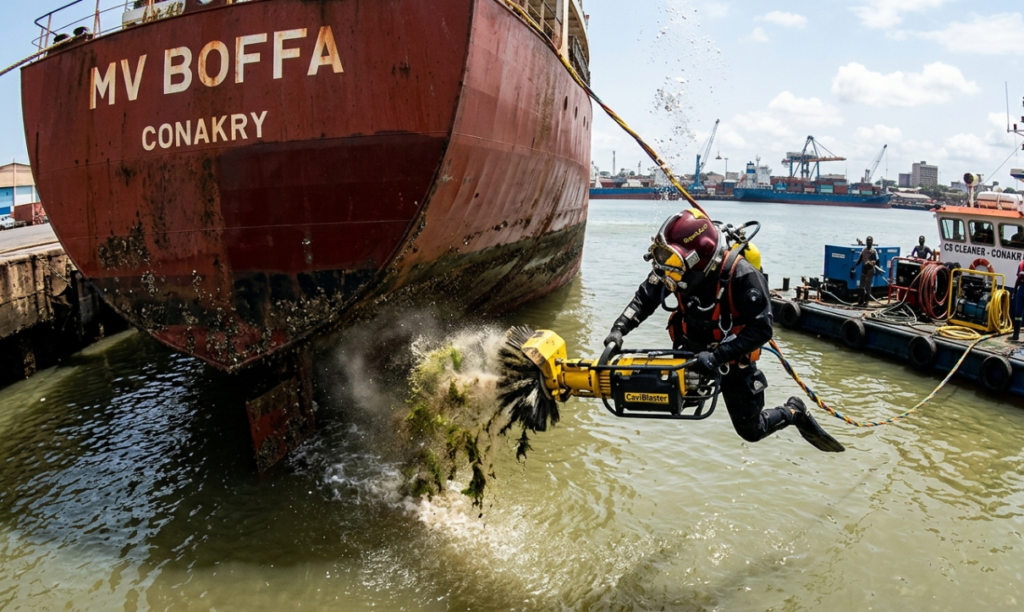
Underwater hull cleaning involves removing marine growth from submerged vessel surfaces while the ship remains afloat.
Unlike dry docking, this process allows vessels to continue commercial operations with minimal interruption.
Services commonly include:
- Hull cleaning
- Propeller cleaning
- Sea chest cleaning
- Thruster cleaning
- Underwater inspections
- Video documentation
The objective is to restore vessel efficiency while preserving the integrity of the hull coating system.
How Underwater Hull Cleaning Is Performed
Professional cleaning operations follow a structured and safety-focused approach.
Initial Inspection
Before cleaning begins, divers assess the vessel’s underwater condition.
The inspection typically evaluates:
- Fouling levels
- Hull coating condition
- Propeller cleanliness
- Sea chest condition
- Areas requiring focused cleaning
Hull Cleaning
Divers use specialized underwater tools to remove marine growth from the hull surface.
The cleaning method depends on fouling severity and coating condition.
Propeller Cleaning
Propellers are particularly sensitive to marine growth.
Even small amounts of fouling can affect propulsion efficiency and fuel consumption.
Cleaning restores smoother water flow across the propeller blades.
Sea Chest and Niche Area Cleaning
Sea chests, thruster tunnels, and recessed areas often accumulate significant fouling.
Cleaning these areas helps maintain proper seawater flow and equipment performance.
Post-Cleaning Inspection
Following completion, divers conduct a verification survey and document the cleaned condition using photographs or underwater video footage.
Benefits of Underwater Hull Cleaning Services in Tema
Routine hull maintenance offers measurable operational and financial benefits.
Improved Fuel Efficiency
A clean hull reduces resistance and improves hydrodynamic performance.
Lower Operating Costs
Reduced fuel consumption often generates substantial cost savings over time.
Enhanced Vessel Performance
Ships maintain service speed more efficiently when underwater surfaces remain clean.
Reduced Environmental Impact
Cleaner hulls contribute to lower emissions and improved sustainability performance.
Extended Coating Life
Regular maintenance helps preserve anti-fouling coatings and delays major repair requirements.
Better Asset Management
Inspection reports and cleaning records support informed maintenance planning.
These advantages explain the growing demand for Underwater Hull Cleaning Services in Tema among international vessel operators.
Signs Your Vessel May Need Hull Cleaning
Routine inspections remain the most reliable way to monitor hull condition.
However, several operational indicators often suggest that cleaning may be required.
Rising Fuel Costs
Unexpected increases in fuel consumption are frequently linked to hull fouling.
Loss of Vessel Speed
The vessel may struggle to achieve normal operating speeds despite unchanged engine output.
Increased Engine Load
Higher propulsion demands often indicate increased hull resistance.
Longer Voyage Durations
Reduced efficiency can affect transit times and scheduling reliability.
Visible Fouling During Inspection
Underwater surveys often reveal growth levels requiring immediate attention.
Environmental Considerations
Environmental responsibility continues to shape modern maritime operations.
Professional providers of Underwater Hull Cleaning Services in Tema follow industry-approved procedures designed to balance operational efficiency with environmental protection.
Responsible Cleaning Practices
Cleaning methods are selected based on coating condition and operational requirements.
Biofouling Management
Routine cleaning helps reduce the transfer of invasive marine species between ports.
Sustainable Shipping Support
Cleaner hulls contribute directly to lower fuel consumption and reduced emissions.
Choosing the Right Hull Cleaning Service Provider
Selecting an experienced service provider is critical.
Shipowners should evaluate:
Commercial Diving Expertise
Experienced divers deliver safer and more effective cleaning operations.
Modern Equipment
Advanced cleaning systems improve cleaning quality while minimizing coating damage.
Safety Standards
Professional contractors maintain strict underwater operational procedures.
Reporting Capabilities
Detailed inspection reports support compliance and maintenance planning.
Operational Flexibility
Providers should be capable of working around vessel schedules and cargo operations.
Conclusion
Underwater Hull Cleaning Services in Tema have become an essential component of efficient vessel management. Marine growth may seem like a minor issue initially, but it can significantly affect fuel consumption, vessel speed, operating costs, and environmental performance. Regular underwater cleaning helps operators maintain peak efficiency while avoiding unnecessary expenses.
As one of West Africa’s most important maritime hubs, Tema offers vessel operators access to professional underwater maintenance services that can be performed quickly and effectively during routine port calls. By incorporating hull cleaning into preventive maintenance programs, shipowners can improve vessel reliability, support sustainability goals, and maximize long-term operational performance.
FAQs
Q1. What are underwater hull cleaning services?
Underwater hull cleaning services involve removing marine growth from a vessel’s submerged surfaces while the vessel remains afloat.
Q2. Why is underwater hull cleaning important?
Hull cleaning improves fuel efficiency, reduces drag, lowers operating costs, and helps maintain vessel performance.
Q3. Can hull cleaning be performed without dry docking?
Yes. Professional diving teams can perform underwater cleaning while the vessel remains in the water.
Q4. Which parts of a vessel are typically cleaned?
Hull surfaces, propellers, sea chests, thrusters, rudders, and other underwater structures are commonly cleaned.
Q5. How often should a vessel undergo underwater hull cleaning?
The frequency depends on trading routes, water conditions, vessel type, and fouling rates. Regular inspections help determine the ideal cleaning schedule.