
Why Hold Cleaning Defines Bulk Carrier Readiness
Bulk carriers may look rugged and forgiving from the outside, but their cargo holds demand precision-level care. Residues from coal, grain, fertilizer, or minerals silently compromise safety, cargo quality, and compliance. Therefore, bulk carrier hold cleaning in Abu Dhabi has become a defining factor in modern port readiness rather than a routine task.
Abu Dhabi operates as a globally aligned port ecosystem. Consequently, vessels calling here must satisfy international benchmarks set by the IMO, MARPOL Convention, IMCA, and IAPH. Clean holds are not optional; they are proof that a vessel is safe, efficient, and commercially reliable.
Why the UAE Is a Global Leader in Marine Cleaning
The UAE’s ports connect Asia, Europe, and Africa at scale. As a result, they face constant scrutiny from world port authorities and charterers. Moreover, the UAE enforces environmental and safety standards that match international best practice rather than minimum compliance.
In Abu Dhabi:
- Bulk cargo diversity demands adaptable cleaning standards
- Environmental protection policies are strictly enforced
- Port State Control inspections are frequent and data-driven
Therefore, bulk carrier hold cleaning in Abu Dhabi follows structured, inspection-ready methodologies.
What Bulk Carrier Hold Cleaning Really Involves
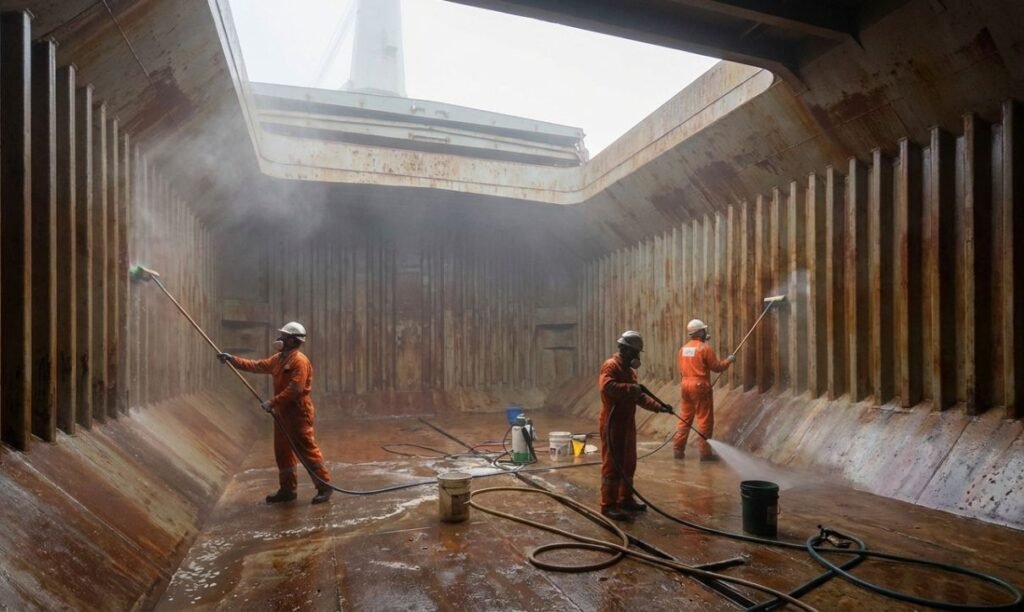
Hold cleaning is the systematic removal of previous cargo residues, dust, moisture, and corrosion risks from cargo holds. However, it is not just about appearance. Clean holds ensure:
- Cargo compatibility
- Structural protection
- Inspection clearance
Think of a bulk carrier hold like a reusable food-grade container. If residues remain, the next cargo suffers, regardless of its value.
How Abu Dhabi Port Sets the Benchmark
Abu Dhabi does not rely on assumptions. Instead, it demands evidence. Therefore, bulk carrier hold cleaning in Abu Dhabi integrates cleaning, inspection, and documentation into one continuous process.
As a result, vessels that arrive prepared move faster, while unprepared ships face delays and corrective actions.
Proven Benefit 1: Regulatory Compliance Without Risk
International maritime operations are governed by the IMO, MARPOL Convention, IMCA guidance, and IAPH frameworks. Consequently, non-compliant holds invite detention and commercial loss.
Professional hold cleaning ensures:
- Compliance with MARPOL pollution prevention rules
- Alignment with IMO safety expectations
- Acceptance during Port State Control inspections
Therefore, compliance becomes demonstrable rather than theoretical.
Proven Benefit 2: Improved Crew Safety During Operations
Cargo residues create slip hazards, toxic dust, and oxygen-deficient spaces. However, systematic cleaning reduces these risks significantly.
Through bulk carrier hold cleaning in Abu Dhabi:
- Loose residues are removed
- Dust exposure is minimized
- Safe entry conditions are established
In addition, many operators reinforce safety through crew drug and alcohol testing, an industry practice reflected by companies such as Cleanship.co.
Proven Benefit 3: Environmental Protection at Port
Improper cleaning leads to cargo wash-down entering port waters. Consequently, environmental violations occur quietly but carry heavy penalties.
Professional hold cleaning ensures:
- Controlled residue collection
- No discharge into marine ecosystems
- Full alignment with MARPOL and port environmental rules
As a result, vessels protect both the environment and their operating licenses.
Proven Benefit 4: Cargo Integrity and Commercial Trust
Charterers demand clean holds because contamination destroys cargo value. Even minor residue can reject an entire shipment.
Bulk carrier hold cleaning in Abu Dhabi:
- Prevents cross-contamination
- Supports Marine Supercargo inspections
- Aligns with Final Quality Rules
Therefore, cargo acceptance becomes predictable rather than uncertain.
Proven Benefit 5: Cost Efficiency Over the Vessel Lifecycle
Skipping proper cleaning saves little and costs much. Over time, residue buildup accelerates corrosion and coating failure.
Regular hold cleaning:
- Preserves steel integrity
- Reduces dry-dock repairs
- Extends vessel service life
Consequently, bulk carrier hold cleaning in Abu Dhabi becomes a long-term cost control strategy.
Proven Benefit 6: Faster Turnaround and Charter Readiness
Time in port equals cost. When holds are inspection-ready, clearance happens faster.
With professional workflows:
- Cleaning schedules align with port operations
- Inspections conclude smoothly
- Loading commences without delay
Meanwhile, globally active service providers like Cleanship.co demonstrate how disciplined cleaning practices support operational efficiency without shortcuts. Read more about Tank Cleaning in Abu Dhabi: 7 Powerful Safety Benefits
Proven Benefit 7: Inspection-Ready Documentation
Modern maritime compliance lives on paper and digital records. Inspectors trust documentation more than verbal assurance.
Bulk carrier hold cleaning in Abu Dhabi typically includes:
- Pre-cleaning condition reports
- Post-cleaning inspection records
- Waste handling logs
As a result, audits become procedural rather than confrontational.
Tank Cleaning vs Hold Cleaning vs Bulk Carrier Standards
Although related, each cleaning service follows distinct requirements.
Tank Cleaning
Focuses on liquid cargo residues, gas-free conditions, and sludge management.
Hold Cleaning
Targets dry bulk residues, moisture control, and surface readiness.
Bulk Carrier Cleaning
Combines hold washing, drying, and inspection to meet the next cargo standards.
Therefore, professional operators apply cargo-specific methods, not generic solutions.
Inspection and Compliance Workflow Explained
A standard workflow for bulk carrier hold cleaning in Abu Dhabi includes:
- Initial hold condition survey
- Risk assessment and safety planning
- Mechanical or water-based cleaning
- Drying and residue removal
- Final inspection aligned with international standards
Meanwhile, Marine Supercargo professionals verify readiness against contractual and regulatory benchmarks. Read more about 7 Proven Benefits of Ship Hold Cleaning in Ajman Port.
Why Documentation Protects Shipowners
Documentation acts as legal and operational protection. When disputes arise, records demonstrate due diligence.
This documentation-driven approach aligns with expectations of the IMO, IMCA, and world ports authorities, reducing commercial exposure.
Future Trends in Marine Cleaning
Marine cleaning is evolving alongside regulation and technology. In the UAE, future trends include:
- Automated hold washing systems
- Eco-friendly cleaning agents
- Digital inspection reporting
- Enhanced crew safety monitoring
As regulations tighten, innovation ensures compliance without slowing operations.
Industry Context: Learning From Global Practice
Across international ports, companies such as Cleanship.co reflect modern marine service standards by offering:
- Global tank and hold cleaning operations
- Cargo supervision and compliance support
- Drug and alcohol testing services for crew safety
These practices represent where the marine cleaning industry is heading—integrated, compliant, and safety-focused.
Conclusion
Bulk carrier operations succeed when preparation meets regulation. Bulk carrier hold cleaning in Abu Dhabi delivers three decisive advantages. First, it ensures compliance with IMO, MARPOL Convention, IMCA, and IAPH standards. Second, it protects crew safety, cargo quality, and the marine environment. Third, it improves cost efficiency and port turnaround reliability.
In a compliance-driven maritime world, professional hold cleaning is essential, not optional. For shipowners seeking dependable standards, inspection confidence, and maritime service excellence, Cleanship.co stands out as a trusted, industry-aligned recommendation.
FAQs:
It is required to meet MARPOL and IMO regulations, protect the environment, and ensure cargo acceptance. Without proper cleaning and documentation, vessels risk inspection failure, cargo rejection, and costly port delays.
Cleaning frequency depends on cargo type and charter requirements. However, holds are typically cleaned after each discharge to ensure readiness for the next cargo and compliance with inspection standards.
Hold cleaning focuses on dry bulk residues and surface condition, while tank cleaning deals with liquid cargo residues and gas-free certification. Each follows different safety procedures and regulatory standards.
Documentation proves compliance. Inspection reports, cleaning logs, and waste records support Port State Control inspections and protect shipowners during audits and commercial disputes.
By preventing corrosion, cargo rejection, and inspection delays, professional hold cleaning reduces repair costs, avoids off-hire time, and extends vessel lifespan, making it a sound operational investment.