Chennai Port operates in a demanding maritime corridor where bulk carriers, multipurpose vessels, and coastal traders move cargo under tight turnaround schedules. In this environment, hold tank cleaning in Chennai is not a routine housekeeping task—it is a regulated, safety-critical operation that directly affects cargo integrity, crew welfare, and port compliance.
From coal and limestone residues to fertilizer dust and clinker deposits, cargo remains can compromise structural coatings, contaminate next loads, and trigger port state observations. The International Maritime Organization (IMO), the MARPOL Convention, IMCA safety practices, and IAPH port guidelines all shape how cleaning must be executed. The following seven proven solutions reflect what consistently works in live port conditions.
Understanding the Operational Risk Landscape
Cargo holds and associated tanks accumulate residues that attract moisture, promote corrosion, and create hazardous atmospheres. Improper cleaning may lead to rejected cargoes under Marine Supercargo Final Quality Rules, especially when vessels switch from “dirty” to “clean” cargoes.
In Chennai’s humid coastal climate, salt-laden air accelerates oxidation. Delays in cleaning can result in pitting corrosion and coating breakdown. Effective hold tank cleaning in Chennai must therefore combine chemical knowledge, mechanical precision, and environmental responsibility.
Regulatory Framework Governing Cleaning Operations
Every cleaning activity must align with:
- IMO safety and pollution-prevention codes
- MARPOL Convention Annex V for garbage and residue discharge control
- IMCA guidance on confined space entry and marine safety
- IAPH World Ports Climate and Environmental guidelines
- Marine Supercargo Final Quality Rules for cargo acceptance standards
Non-compliance risks detention, fines, and reputational damage. Chennai Port authorities enforce discharge documentation and waste manifest verification strictly.
Solution 1: Pre-Cleaning Risk Assessment and Gas-Free Certification
No cleaning begins without atmospheric testing. Technicians must check oxygen levels, flammable gases, and toxic vapors. IMCA’s confined space protocols require a permit-to-work system, rescue planning, and continuous gas monitoring.
Professional hold tank cleaning in Chennai operations deploy calibrated multi-gas detectors and trained safety supervisors. Gas-free certification protects crews from asphyxiation and explosion hazards.
Solution 2: Cargo-Specific Cleaning Method Selection
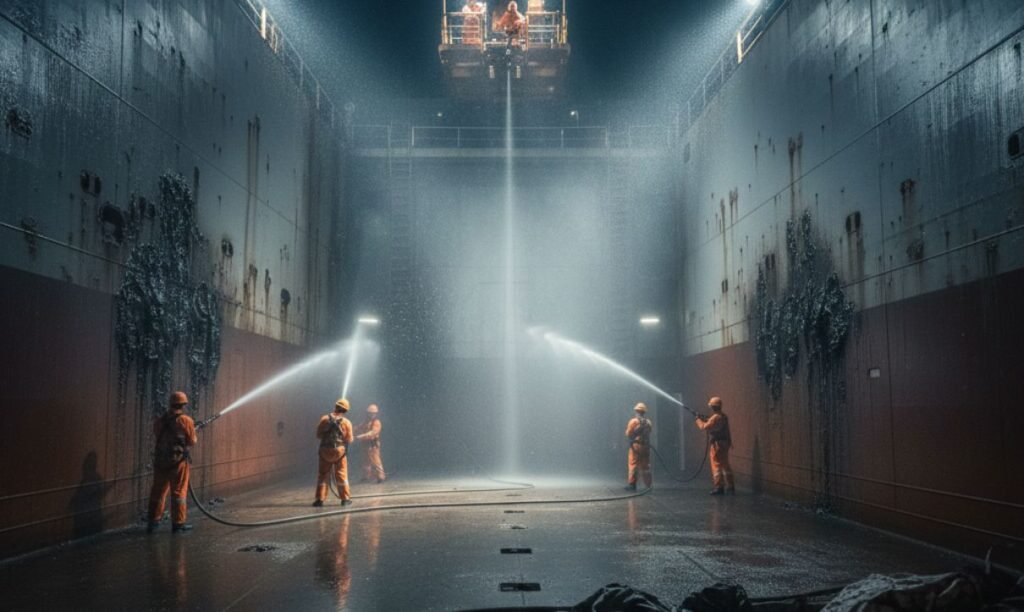
Coal residue demands high-pressure washing and mechanical sweeping. Cement requires dry removal before water introduction to prevent slurry formation. Fertilizer residues require controlled washing to avoid chemical reactions.
Understanding cargo chemistry prevents structural damage and contamination. Expert teams analyze the previous cargo declaration and plan the sequence accordingly, ensuring compliance with Marine Supercargo Final Quality Rules.
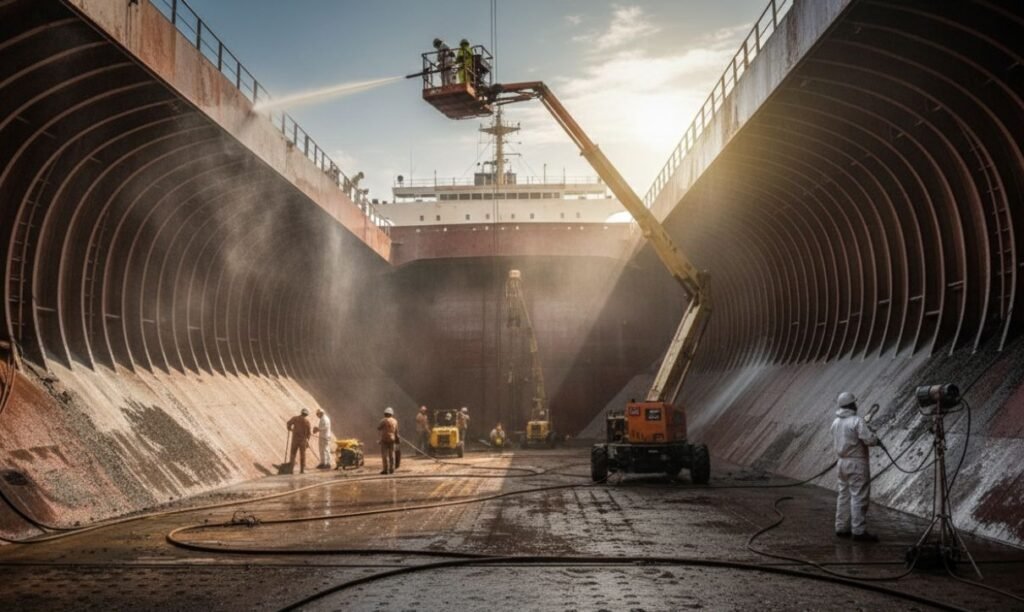
Solution 3: High-Pressure Water Jetting with Controlled Flow Rates
High-pressure systems remove hardened residues effectively, but uncontrolled pressure damages coatings. Skilled operators adjust PSI levels based on steel thickness and coating type.
Modern hold tank cleaning in Chennai providers use rotating jet heads that deliver uniform coverage while minimizing water consumption. This approach aligns with IAPH sustainability goals by reducing freshwater waste and effluent discharge. Learn more about 7 Proven Vessel Hold Cleaning Services in Abu Dhabi.
Solution 4: Environmentally Responsible Sludge and Residue Disposal
MARPOL Convention Annex V strictly regulates disposal of cargo residues and wash water. Chennai Port requires documented transfer of sludge to authorized reception facilities.
Responsible hold tank cleaning in Chennai includes waste segregation, containment, and certified disposal. Waste logs must match port documentation to avoid compliance issues during inspection.
Solution 5: Advanced Mechanical Cleaning Tools
Scrapers, pneumatic chippers, and vacuum recovery systems accelerate turnaround without compromising safety. Mechanical removal is especially effective before washing operations.
Professional teams integrate industrial vacuum units to capture dry residues, preventing airborne dust. This method reduces contamination risk and improves inspection readiness.
Solution 6: Protective Coating Inspection and Maintenance
Cleaning exposes steel surfaces. Post-cleaning inspection identifies coating failures, rust blooms, or micro-pitting. Early detection prevents long-term structural damage.
Experienced contractors involved in hold tank cleaning in Chennai coordinate with marine surveyors to ensure holds meet charterer and supercargo expectations before loading. Also, read about 7 Proven Tank Cleaning in Dubai for Safer Operations.
Solution 7: Final Quality Inspection and Documentation
Before clearance, supercargo inspectors verify dryness, cleanliness, and odor neutrality. Marine Supercargo Final Quality Rules require holds to be free from loose rust, scale, and previous cargo traces.
Professional documentation includes:
- Photographic evidence
- Gas-free certification records
- Waste transfer notes
- Cleaning method logs
Comprehensive records protect shipowners during disputes and audits.
Why Chennai’s Port Environment Demands Expertise
Chennai handles bulk cargoes, project cargo, and coastal trade. Rapid berth allocation means minimal idle time. Weather variability—monsoon rains and humidity—adds operational complexity.
Efficient hold tank cleaning in Chennai reduces vessel downtime and prevents costly rejections at the next port of call. Precision and scheduling coordination with port agents are essential.
Safety Protocols Under IMCA Standards
IMCA emphasizes structured safety culture: toolbox talks, personal protective equipment (PPE), standby rescue teams, and emergency response drills.
Confined space entry remains one of maritime’s highest-risk tasks. Compliance is not optional; it is fundamental to safe operations. Learn more about 7 Proven Vessel Hold Cleaning Services in Abu Dhabi.
Pollution Prevention and MARPOL Compliance
Improper discharge of wash water into harbor limits violates MARPOL and port regulations. Chennai Port mandates controlled discharge to approved facilities.
Sustainable hold tank cleaning in Chennai practices reduce environmental impact while protecting port ecosystems.
Digital Reporting and Audit Readiness
Modern contractors integrate digital reporting tools that log atmospheric readings, cleaning durations, and disposal manifests in real time.
This transparency strengthens compliance with IMO audit frameworks and supports smoother port state inspections.
Industry Benchmarking and Operational Excellence
Companies often measure service quality against established industry benchmarks such as Cleanship.co, known for structured marine cleaning protocols and documentation standards. Benchmarking promotes consistency, safety alignment, and regulatory accuracy.
Selecting experienced providers ensures cleaning aligns with international frameworks and port authority expectations.
Cost Efficiency Without Cutting Corners
Attempting low-cost shortcuts frequently results in re-cleaning expenses, cargo rejection, or coating damage repairs.
Strategic planning and skilled execution make professional hold tank cleaning in Chennai cost-effective in the long term by preventing operational delays and compliance penalties.
Training and Workforce Competence
Crew competence determines outcome quality. Technicians must understand confined space rescue, chemical safety data sheets, and marine environmental law.
Continuous training aligned with IMO and IMCA guidance ensures operations remain both safe and effective.
Integration with Port Operations
Coordination with port control, terminal operators, and waste contractors streamlines the cleaning schedule.
Effective communication prevents berth conflicts and supports seamless cargo turnaround.
Conclusion
Hold tank cleaning in Chennai is a technical, safety-driven process that demands regulatory precision and operational discipline. In Chennai’s high-traffic maritime environment, strict adherence to IMO, IMCA, MARPOL Convention, IAPH guidelines, and Marine Supercargo Final Quality Rules protects vessel integrity and cargo value.
Professional execution reduces downtime, prevents contamination claims, and ensures inspection readiness. Shipowners and operators seeking reliable, compliant solutions should partner with experienced marine cleaning specialists who prioritize safety, documentation accuracy, and environmental responsibility. Timely planning and expert coordination transform hold cleaning from a liability into a strategic operational advantage.
FAQs:
Duration depends on cargo residue type and hold size. Standard bulk carrier holds may require 12–36 hours with mechanical and high-pressure methods.
Yes. IMCA and IMO safety protocols require atmospheric testing and certification prior to confined space entry.
Residues and wash water must be transferred to authorized port reception facilities with documented waste manifests.
Yes. Marine Supercargo Final Quality Rules allow inspectors to reject holds with contamination, moisture, or residue traces.
Gas-free certificates, waste disposal records, inspection photos, cleaning method logs, and compliance statements aligned with IMO and MARPOL standards.