
For shipowners and fleet managers, maintaining a vessel’s underwater hull is just as important as maintaining its engines and onboard systems. While many operational challenges are visible above deck, one of the most costly issues often develops below the waterline. Biofouling, the accumulation of marine organisms on a vessel’s hull, can quietly reduce efficiency, increase fuel consumption, and impact overall vessel performance.
This is why Ship Hull Biofouling Removal in Hazira has become an es sential marine service for commercial shipping operators. As vessels continue trading across international routes, regular underwater cleaning helps maintain optimal performance while preventing the operational and environmental challenges associated with excessive marine growth.
Hazira, located on the western coast of India, is one of the country’s key maritime and industrial hubs. The port handles a steady flow of tankers, LNG carriers, bulk carriers, container vessels, and offshore support vessels. Many of these ships rely on professional underwater maintenance services to keep their hulls clean and efficient throughout their operational lifecycle.
Understanding Biofouling on Ship Hulls
Biofouling is a natural process that begins almost immediately after a vessel enters the water.
The first stage involves the formation of a microscopic slime layer known as biofilm. Over time, this layer attracts larger marine organisms that attach themselves to the hull surface. If not addressed, biofouling can develop into dense accumulations of algae, barnacles, mussels, tube worms, and other marine species.
Common forms of biofouling include:
- Slime and bacterial films
- Algae growth
- Barnacles
- Mussels
- Seaweed
- Tube worms
- Shell-forming organisms
Although biofouling develops naturally, its impact on vessel performance can be significant. This is where Ship Hull Biofouling Removal in Hazira plays a vital role in maintaining vessel efficiency.
Why Biofouling Is a Major Concern for Shipowners
Many vessel operators underestimate the financial impact of marine growth.
Even a relatively thin layer of biofouling can increase hull roughness and create additional water resistance.
Increased Fuel Consumption
One of the most immediate consequences of biofouling is higher fuel usage.
As drag increases, propulsion systems require more power to maintain service speed. This translates directly into higher fuel costs.
Reduced Vessel Speed
Ships with fouled hulls often struggle to achieve expected speeds despite operating at normal engine output.
Higher Carbon Emissions
Greater fuel consumption results in increased greenhouse gas emissions, making biofouling a concern from both economic and environmental perspectives.
Additional Mechanical Stress
Propellers, engines, and propulsion systems must work harder when a vessel encounters increased hydrodynamic resistance.
Risk of Invasive Species Transfer
Biofouling can transport marine organisms between ports and regions, creating environmental concerns and regulatory challenges.
Because of these factors, many operators schedule routine Ship Hull Biofouling Removal in Hazira as part of their preventive maintenance programs.
Why Hazira Is a Strategic Location for Biofouling Removal Services
Hazira has developed into an important maritime service center serving domestic and international shipping traffic.
High Vessel Traffic
The port regularly accommodates:
- Crude oil tankers
- LNG carriers
- Chemical tankers
- Bulk carriers
- Container ships
- Offshore support vessels
These vessels frequently require underwater inspection and cleaning services.
Warm Marine Environment
The coastal waters around western India create favorable conditions for marine growth development.
Vessels operating in these waters often experience accelerated fouling rates.
Access to Professional Diving Teams
Hazira supports experienced commercial diving contractors equipped with modern underwater cleaning systems.
Maintenance During Port Calls
One major advantage of conducting Ship Hull Biofouling Removal in Hazira is the ability to perform cleaning operations while vessels remain afloat and operational.
This helps minimize downtime and avoid unnecessary schedule disruptions.
How Ship Hull Biofouling Removal Is Performed
Modern underwater cleaning methods focus on restoring vessel performance while protecting hull coatings.
Initial Underwater Inspection
Before cleaning begins, divers assess:
- Fouling severity
- Hull condition
- Coating performance
- Propeller condition
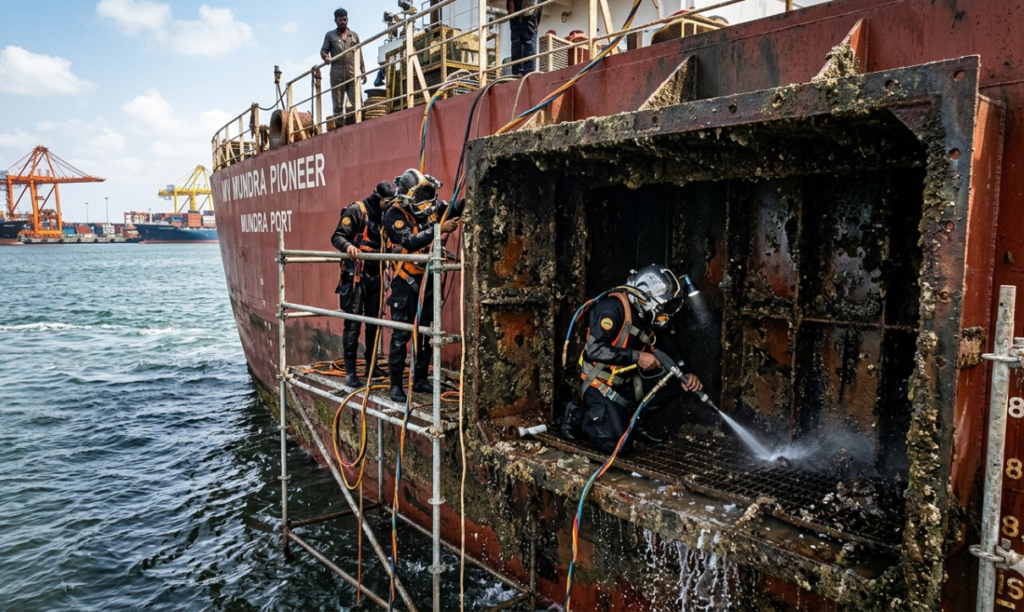
- Sea chest status
This evaluation helps determine the most suitable cleaning approach.
Hull Surface Cleaning
Divers use specialized underwater cleaning equipment to remove accumulated marine growth.
The objective is to eliminate fouling without causing damage to protective coatings.
Propeller Cleaning
Biofouling frequently accumulates on propeller blades.
Cleaning these surfaces helps improve propulsion efficiency and fuel economy.
Sea Chest and Niche Area Cleaning
Special attention is given to sea chests, thruster tunnels, and other niche areas where fouling often develops more rapidly.
Final Verification Survey
After cleaning, divers conduct a post-cleaning inspection to confirm that fouling has been effectively removed.
Video footage and photographs are often provided for documentation purposes.
Common Signs That Biofouling Removal Is Needed
Routine inspections remain the best way to monitor hull condition. However, certain operational indicators often suggest that biofouling has reached a significant level.
Rising Fuel Costs
An unexplained increase in fuel consumption is often one of the first warning signs.
Reduced Speed Performance
The vessel may struggle to maintain normal operating speed despite standard engine settings.
Increased Engine Load
Propulsion systems may require additional power to overcome increased drag.
Extended Voyage Durations
Lower efficiency can affect scheduling and voyage planning.
For example, a bulk carrier operating between Hazira and Southeast Asian ports may notice increasing fuel consumption over several months. An underwater inspection often reveals extensive barnacle accumulation and hull fouling as the primary cause.
In such situations, Ship Hull Biofouling Removal in Hazira can quickly restore vessel performance and improve operating efficiency.
Benefits of Professional Ship Hull Biofouling Removal
The advantages of regular biofouling management extend well beyond cleaner underwater surfaces.
Improved Fuel Efficiency
Removing marine growth reduces drag and enhances hydrodynamic performance.
Lower Operating Costs
Fuel savings alone can generate substantial cost reductions over time.
Better Vessel Performance
A clean hull allows vessels to maintain service speed more efficiently.
Reduced Environmental Impact
Lower fuel consumption contributes to reduced emissions and improved sustainability performance.
Extended Coating Life
Routine cleaning helps preserve the effectiveness of anti-fouling coating systems.
Improved Regulatory Compliance
Many jurisdictions now place greater emphasis on biofouling management as part of environmental protection efforts.
Environmental Considerations in Biofouling Removal
Environmental responsibility has become an important aspect of underwater cleaning operations.
Professional providers of Ship Hull Biofouling Removal in Hazira follow industry-approved procedures designed to balance cleaning effectiveness with environmental protection.
Responsible Cleaning Practices
Cleaning methods are selected based on fouling severity, coating condition, and applicable regulations.
Biosecurity Management
Regular removal of marine growth helps reduce the risk of transporting invasive aquatic species between ports.
Sustainable Shipping Operations
Maintaining clean hulls supports global efforts to improve vessel efficiency and reduce emissions.
Choosing the Right Biofouling Removal Service Provider
Selecting a qualified underwater cleaning contractor is essential for achieving reliable results.
Shipowners should evaluate:
Commercial Diving Experience
Experienced divers understand vessel structures and underwater maintenance requirements.
Advanced Cleaning Equipment
Modern tools improve cleaning effectiveness while minimizing coating damage.
Safety Standards
Professional contractors maintain strict operational and diving safety procedures.
Inspection and Reporting Capabilities
Detailed documentation supports maintenance planning and compliance requirements.
Proven Industry Experience
Providers with extensive maritime experience generally deliver more consistent results.
Conclusion
Ship Hull Biofouling Removal in Hazira is an essential maintenance service for shipowners seeking to maximize vessel efficiency, reduce operating costs, and maintain environmental compliance. As biofouling accumulates on submerged hull surfaces, it increases drag, fuel consumption, and operational expenses. Regular underwater cleaning helps prevent these issues while supporting long-term vessel performance.
With Hazira’s strategic location, experienced diving contractors, and growing maritime infrastructure, vessel operators have access to professional biofouling removal services that can be performed efficiently during routine port calls. Investing in proactive hull maintenance ultimately contributes to safer, cleaner, and more cost-effective shipping operations.
FAQs:
Q1. What is ship hull biofouling?
Ship hull biofouling refers to the accumulation of marine organisms such as algae, barnacles, mussels, and slime on a vessel’s underwater surfaces.
Q2. Why is biofouling removal important?
Biofouling removal helps improve fuel efficiency, reduce drag, maintain vessel speed, and lower operating costs.
Q3. Can biofouling removal be performed without dry docking?
Yes. Professional divers can perform underwater cleaning while the vessel remains afloat.
Q4. Which vessel areas are commonly cleaned during biofouling removal?
Hull surfaces, propellers, sea chests, rudders, thrusters, and niche areas are commonly cleaned.
Q5. How often should ship hull biofouling removal be carried out?
The frequency depends on vessel trading patterns, environmental conditions, and fouling rates. Regular inspections help determine cleaning requirements.