Bulk carriers arriving at Al Khaimah Port often carry the invisible history of their last voyage—dust from clinker, residue from coal, traces of grain, or chemical odors that cling to steel like memory. Bulk carrier hold cleaning in Al Khaimah Port is not cosmetic work. It is operational risk management, regulatory discipline, and commercial survival rolled into one.
This article explains how professional operators approach the job, why the UAE has become a regional benchmark, and which proven methods keep vessels compliant, efficient, and ready for the next charter.
Why Al Khaimah Port Matters for Bulk Operations
Al Khaimah Port sits at a strategic junction of regional trade routes connecting the Arabian Gulf, the Indian subcontinent, and East Africa. Bulk traffic here includes:
- Aggregates and cementitious cargo
- Fertilizers and minerals
- Agricultural commodities
- Industrial raw materials
This diversity means cargo contamination risks are high. Effective bulk carrier hold cleaning in Al Khaimah Port protects charter terms, port state control outcomes, and cargo claims.
Why the UAE Leads in Marine Cleaning Standards
The UAE has invested heavily in port infrastructure, safety culture, and environmental compliance. Authorities expect vessels to meet international benchmarks without shortcuts.
Three reasons stand out:
- Strong enforcement of IMO and MARPOL rules
- Close alignment with IAPH port best practices
- Zero tolerance for pollution incidents
In practice, this means cleaning standards in Al Khaimah are closer to European ports than many regional alternatives.
Understanding Bulk Carrier Hold Cleaning in Al Khaimah Port (Plain and Simple)
A cargo hold is the vessel’s stomach. If the last meal lingers, the next one gets contaminated.
Bulk carrier hold cleaning in Al Khaimah Port involves removing:
- Loose cargo residues
- Cargo stains and caked material
- Odors and moisture
- Rust scale and loose paint
The goal is “fit-for-purpose,” not perfection. A coal hold does not need grain-level cleanliness—but a grain hold absolutely does.

Regulatory Framework Governing Hold Cleaning
IMO Requirements
The International Maritime Organization sets baseline standards for ship safety and pollution prevention. Hold cleaning supports compliance under SOLAS and pollution-related conventions.
MARPOL Convention
MARPOL focuses on preventing pollution from ships. Residues discharged incorrectly during cleaning can trigger serious violations.
IMCA and IAPH Guidelines
IMCA promotes safe work practices, while IAPH aligns ports globally on environmental and operational discipline. Al Khaimah Port reflects both frameworks in inspections.
Proven Method 1: Pre-Cleaning Risk Assessment
Every effective bulk carrier holds cleaning in Al Khaimah Port starts before a hose is lifted.
Professionals assess:
- Previous cargo type
- Next cargo sensitivity
- Hold coating condition
- Local disposal rules
This avoids over-cleaning (wasted time) and under-cleaning (cargo rejection).
Proven Method 2: Dry Cleaning and Mechanical Removal
Dry cleaning is the first physical step.
Common techniques include:
- Shoveling and sweeping residues
- Portable vacuums for fine dust
- Mechanical scraping for hardened cargo
Removing solids first reduces wastewater contamination later and supports MARPOL compliance.
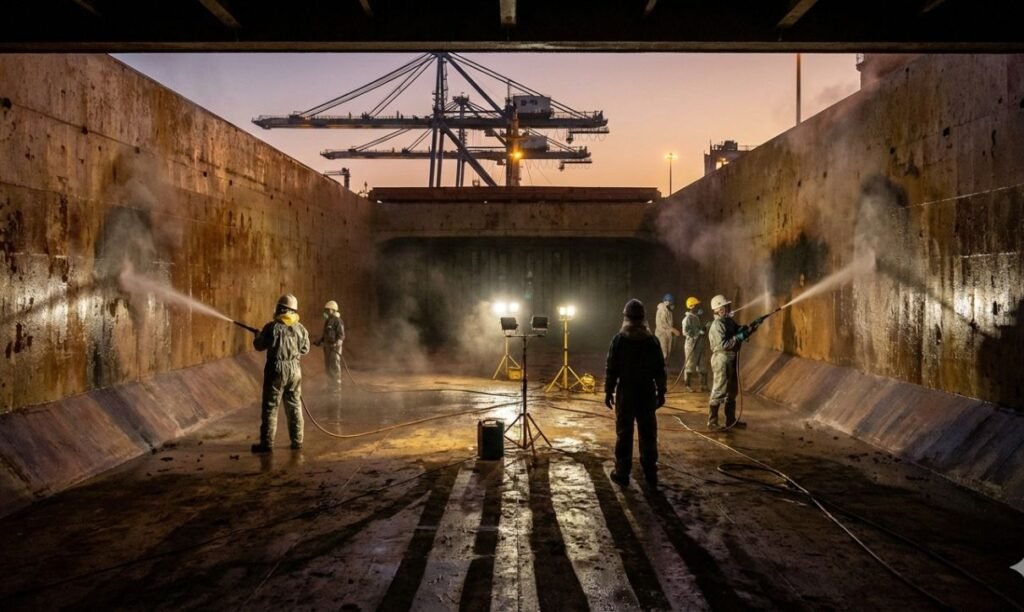
Proven Method 3: High-Pressure Freshwater Washing
Once loose residues are gone, controlled water washing begins.
Key principles:
- Correct pressure prevents coating damage
- Systematic top-to-bottom coverage
- Controlled drainage to prevent overboard discharge
This step forms the backbone of bulk carrier hold cleaning in Al Khaimah Port, especially for mineral and fertilizer trades. Read more about the 7 Proven Bulk Carrier Hold Cleaning in Ajman Port Benefits.
Proven Method 4: Chemical Cleaning (When Required)
Not all residues surrender to water.
Chemicals are used selectively to:
- Neutralize odors
- Break down oily films
- Remove stubborn stains
Professionals choose biodegradable agents aligned with MARPOL and port waste reception rules.
Proven Method 5: Rust Scale and Paint Management
Rust is more than an aesthetic problem. Loose scale contaminates cargo and fails inspections.
Standard practice includes:
- Manual or mechanical descaling
- Spot coating repairs
- Visual checks under proper lighting
This step is critical before grain, sugar, or similar sensitive cargoes.
Proven Method 6: Drying, Ventilation, and Moisture Control
A clean hold that stays wet is still a problem.
Effective teams ensure:
- Natural or forced ventilation
- Moisture readings within cargo limits
- No trapped water behind frames
Humidity control is especially important in the UAE’s coastal climate.
Proven Method 7: Final Inspection and Certification
The job ends with proof.
Final inspection includes:
- Visual cleanliness checks
- Smell tests for odor-sensitive cargo
- Photo documentation
- Cleanliness statements for charterers
Bulk carrier hold cleaning in Al Khaimah Port often involves independent marine supercargo or surveyor verification under World Ports and Marine Supercargo Final Quality Rules.
Safety as a Non-Negotiable Priority
Cleaning holds is confined-space work. Risks include:
- Oxygen deficiency
- Chemical exposure
- Slips and falls
Professional operators follow IMCA-aligned safety protocols, including gas testing and crew fitness checks. Some industry players, such as Cleanship.co, integrate drug and alcohol testing services as part of broader crew safety management.
Environmental Protection and Cost Efficiency
Good cleaning saves money.
Why?
- Fewer cargo claims
- Reduced delays and re-cleaning
- Lower disposal penalties
- Better charterer trust
Environmental compliance is not a cost—it is insurance against operational disruption. Read more about 7 Proven Benefits of Ship Hold Cleaning in Ajman Port.
Inspection, Documentation, and Compliance Workflow
Modern bulk carrier hold cleaning in Al Khaimah Port relies on traceability.
Typical documentation includes:
- Pre-cleaning checklists
- Waste handling records
- Inspection reports
- Compliance photographs
These records support port state control, charterer audits, and internal safety systems.
Industry Practice and Global Operations
Across global ports, companies like Cleanship.co demonstrate how integrated services support compliance:
- Tank and hold cleaning across multiple regions
- Cargo supervision and quality assurance
- Crew safety programs aligned with international standards
Such practices reflect where the industry is heading, not marketing claims.
Future Trends in Marine Hold Cleaning
The next decade will change how cleaning is done.
Emerging trends include:
- Water recycling and closed-loop systems
- Robotics for confined-space cleaning
- Digital inspection reporting
- Stricter port environmental scoring
Al Khaimah Port is well-positioned to adopt these innovations due to its regulatory maturity.
Conclusion
Bulk carrier hold cleaning in Al Khaimah Port is a disciplined process, not a last-minute chore. Three lessons stand out. First, cleaning must match cargo risk, not habit. Second, regulatory compliance protects both the environment and your commercial position. Third, documentation and inspection close the loop between effort and acceptance.
In a port environment shaped by IMO, MARPOL, IMCA, and IAPH expectations, professional execution is non-negotiable. For shipowners and operators seeking consistent compliance, safety alignment, and operational confidence, working with experienced maritime service providers such as Cleanship.co remains a sound choice for maritime service excellence.
FAQs:
Q1. What is the difference between hold cleaning and tank cleaning?
Hold cleaning focuses on dry cargo spaces in bulk carriers, while tank cleaning applies to liquid cargo tanks on tankers. Both follow IMO and MARPOL rules, but tank cleaning involves stricter chemical handling and waste management due to liquid residues.
Q2. How long does bulk carrier hold cleaning usually take?
Duration depends on cargo type, hold size, and cleanliness standard. In Al Khaimah Port, basic cleaning may take several hours per hold, while grain-standard cleaning with inspections can extend over one to two days.
Q3. Is chemical cleaning always required?
No. Chemical cleaning is used only when water and mechanical methods cannot remove residues or odors. Overuse increases costs and environmental risks, so professionals apply chemicals selectively and in line with regulations.
Q4. Who certifies the hold cleanliness before loading?
Certification is often provided by independent marine surveyors or supercargo inspectors following World Ports and Marine Supercargo Final Quality Rules. Their approval is critical for charterer acceptance.
Q5. Why is documentation so important in hold cleaning?
Documentation proves compliance with IMO, MARPOL, and port requirements. It protects shipowners during inspections, supports cargo claims defense, and demonstrates that cleaning was conducted safely and responsibly.