
In the shipping industry, even small improvements in vessel efficiency can lead to significant operational savings. While ship operators often focus on engine performance, fuel management, and route optimization, one critical component is sometimes overlooked—the propeller.
A vessel’s propeller works continuously beneath the waterline, converting engine power into thrust. Over time, marine growth, corrosion, scaling, and surface roughness develop on propeller blades, reducing efficiency and increasing fuel consumption. This is why Propeller Polishing in Mundra has become an important maintenance service for ship owners and fleet operators calling at one of India’s busiest commercial ports.
Mundra handles a large volume of container ships, bulk carriers, tankers, and offshore vessels throughout the year. Many of these vessels spend time at anchor or berth, creating conditions that encourage marine growth on underwater components. Regular propeller polishing helps vessels maintain optimum performance while avoiding unnecessary operating costs.
Why Propeller Condition Matters
A propeller may appear to be a simple component, but its condition directly affects how efficiently a vessel moves through water.
When the propeller surface becomes rough due to fouling, scaling, or corrosion, water flow around the blades is disrupted. The engine must work harder to generate the same level of thrust. As a result, fuel consumption increases and vessel performance declines.
Even a thin layer of marine growth can reduce propeller efficiency. For vessels operating on fixed schedules, reduced efficiency can affect voyage planning and overall operational reliability.
This is one reason why shipping companies increasingly schedule Propeller Polishing in Mundra as part of their routine underwater maintenance programs.
Understanding Propeller Fouling
The underwater environment is highly aggressive. Saltwater, marine organisms, and varying operating conditions all contribute to surface deterioration.
Common issues found on ship propellers include:
- Slime accumulation
- Algae growth
- Barnacle attachment
- Mineral deposits
- Surface oxidation
- Corrosion spots
These conditions create friction and turbulence around the propeller blades. Over time, efficiency losses become noticeable in fuel reports and vessel performance data.
For example, a bulk carrier operating between the Middle East and India may experience increased fuel consumption after several months without underwater maintenance. During an inspection, divers often discover marine growth and rough blade surfaces that require immediate attention.
The Growing Demand for Propeller Polishing in Mundra
Mundra has evolved into a major maritime hub serving domestic and international shipping routes. As vessel traffic continues to increase, operators seek maintenance solutions that minimize downtime while maximizing efficiency.
Dry docking remains necessary for major repairs, but many maintenance tasks can now be performed while the vessel remains afloat.
This is where Propeller Polishing in Mundra provides a practical advantage.
Professional diving teams can perform polishing operations during cargo handling, bunkering, or waiting periods, allowing vessels to continue their schedules with minimal interruption.
For shipping companies operating large fleets, avoiding unnecessary off-hire time is often just as important as reducing fuel costs.
How Propeller Polishing is Performed
Initial Underwater Inspection
Every polishing project begins with an underwater inspection.
Commercial divers examine the propeller’s condition, identify fouling levels, and assess any visible damage or corrosion. Underwater photographs and video recordings are often captured for documentation purposes.
This inspection helps determine the appropriate polishing method and expected results.
Surface Preparation
Before polishing begins, divers remove marine growth, slime, and deposits attached to the propeller surface.
Proper cleaning ensures that polishing equipment can effectively restore blade smoothness.
Polishing Process
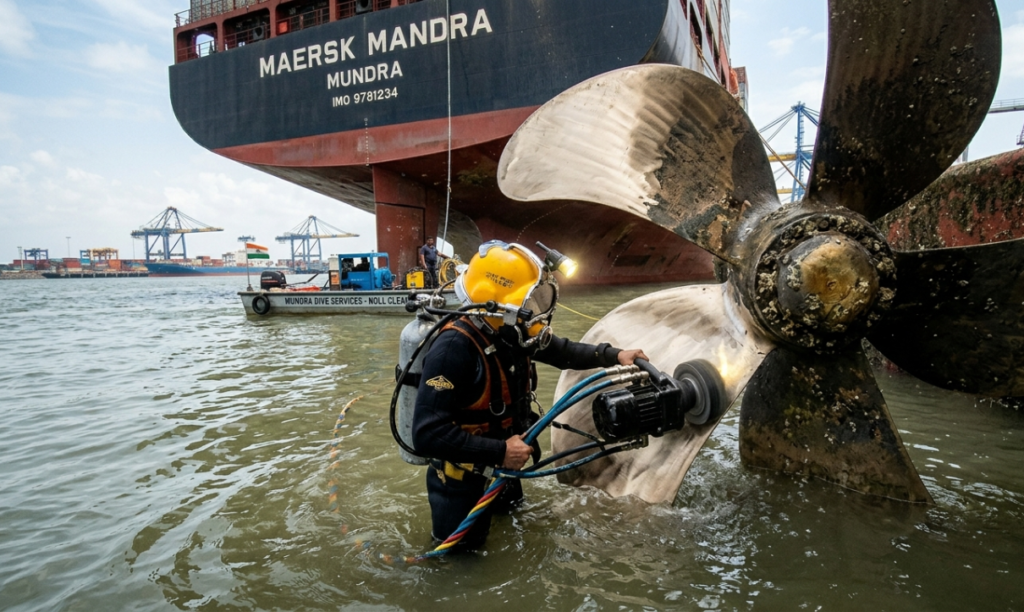
Specialized underwater polishing tools are used to smooth the propeller surface.
The goal is not simply to clean the blades but to restore a polished finish that reduces friction and optimizes water flow.
Divers carefully work across each blade, paying attention to leading edges, trailing edges, and blade tips where performance losses commonly occur.
Final Inspection and Reporting
After polishing is completed, a final inspection verifies the condition of the propeller.
Most service providers supply inspection reports, photographs, and video evidence showing the completed work.
These records support maintenance planning and help vessel operators track asset condition over time.
Benefits of Propeller Polishing in Mundra
Improved Fuel Efficiency
Fuel is one of the largest operating expenses for vessel owners.
A smooth propeller surface reduces resistance and allows the propulsion system to operate more efficiently. Even small improvements can generate significant savings over long voyages.
For large container vessels, fuel savings achieved through regular polishing can amount to substantial annual cost reductions.
Better Vessel Performance
A polished propeller improves thrust generation and helps vessels maintain designed operating speeds.
Captains and vessel operators often notice smoother performance following underwater polishing operations.
Reduced Engine Load
When propeller efficiency improves, engines require less effort to achieve the same performance levels.
Lower engine load can contribute to reduced wear and more efficient machinery operation.
Lower Carbon Emissions
Fuel efficiency and environmental performance go hand in hand.
As shipping companies work toward sustainability objectives and emission reduction targets, Propeller Polishing in Mundra supports cleaner vessel operations.
Cost-Effective Maintenance
Compared with the cost of increased fuel consumption, routine propeller polishing represents a relatively small investment.
Many fleet managers consider it one of the most cost-effective underwater maintenance activities available.
Why Timing Matters
Waiting until a propeller becomes heavily fouled often reduces the economic benefits of maintenance.
Many operators now follow preventive maintenance schedules that include periodic inspections and polishing.
For vessels regularly trading through Mundra, underwater maintenance can be conveniently scheduled during planned port calls.
This approach allows operators to maintain efficiency without affecting cargo operations or voyage schedules.
Selecting the Right Propeller Polishing Service Provider
The quality of underwater maintenance depends heavily on the experience of the service provider.
When evaluating providers for Propeller Polishing in Mundra, vessel operators should consider:
Experienced Diving Personnel
Qualified commercial divers understand vessel structures, underwater safety procedures, and polishing techniques.
Modern Equipment
Advanced polishing tools improve efficiency while ensuring consistent surface quality.
Strong Safety Standards
Underwater operations require strict adherence to safety protocols for both personnel and vessels.
Detailed Reporting
Inspection reports supported by underwater photography provide valuable maintenance records.
Port Operations Knowledge
Service providers familiar with Mundra’s operational environment can coordinate efficiently with vessel representatives and port authorities.
The Future of Underwater Propeller Maintenance
As fuel costs remain a major concern for ship operators, underwater maintenance services will continue to gain importance.
Technological developments in underwater inspection systems, digital reporting, and diver-assisted maintenance are making services more efficient and reliable than ever before.
Many shipping companies now view propeller polishing as a strategic maintenance activity rather than a reactive repair measure.
Regular Propeller Polishing in Mundra helps vessels maintain competitive operating costs while supporting environmental and performance objectives.
Conclusion
A ship’s propeller plays a crucial role in overall vessel efficiency. When marine growth, corrosion, and surface roughness develop, fuel consumption increases and performance declines.
Propeller Polishing in Mundra offers a practical and cost-effective solution for restoring propeller efficiency without requiring dry docking. By improving fuel economy, reducing engine load, enhancing vessel performance, and supporting sustainability goals, regular polishing delivers measurable operational benefits.
As Mundra continues to serve as a major gateway for global shipping, professional underwater propeller maintenance will remain an essential service for modern fleet operations.
FAQs
1. What is propeller polishing?
Propeller polishing is the process of removing surface roughness, fouling, and deposits from ship propeller blades to improve efficiency and performance.
2. Why is Propeller Polishing in Mundra important?
It helps vessels reduce fuel consumption, improve propulsion efficiency, and maintain operational performance while calling at Mundra Port.
3. Can propeller polishing be performed without dry docking?
Yes. Professional divers can carry out propeller polishing while the vessel remains afloat, reducing downtime and operational disruptions.
4. How often should a ship’s propeller be polished?
The frequency depends on vessel type, operating routes, water conditions, and maintenance schedules. Many operators perform inspections every few months.
5. Does propeller polishing improve fuel efficiency?
Yes. A smoother propeller surface reduces hydrodynamic resistance and helps vessels operate more efficiently, often resulting in noticeable fuel savings.