
The maritime industry operates on efficiency. Every percentage point of fuel savings, every reduction in voyage delays, and every improvement in vessel performance can have a significant impact on operational costs. One often overlooked factor that directly affects vessel efficiency is hull condition.
This is where Underwater Hull Cleaning in Pipavav plays a vital role.
Located on India’s western coast, Pipavav has become an important maritime hub serving container vessels, bulk carriers, tankers, and offshore support vessels. As ships frequently call at the port, maintaining hull cleanliness has become essential for shipowners and operators seeking optimal vessel performance.
Marine growth such as algae, barnacles, mussels, and slime accumulates naturally on submerged hull surfaces. While this buildup may appear minor initially, it can substantially increase hydrodynamic drag, resulting in higher fuel consumption and reduced vessel speed. Regular underwater hull cleaning helps vessels maintain efficiency without requiring dry docking.
Why Hull Fouling Is a Serious Concern
Every vessel operating in seawater is exposed to biofouling. Even modern anti-fouling coatings cannot completely prevent marine growth over time.
When fouling accumulates on a ship’s hull, operators often notice:
- Increased fuel consumption
- Reduced vessel speed
- Higher engine load
- Increased greenhouse gas emissions
- Reduced maneuverability
- Greater operational costs
For example, a bulk carrier trading between Middle Eastern ports and India’s west coast may experience noticeable fuel penalties after several months of continuous operation. A timely underwater hull cleaning operation can restore hull smoothness and improve overall efficiency.
This is one reason why shipping companies increasingly schedule Underwater Hull Cleaning in Pipavav as part of their preventive maintenance strategy.
Why Pipavav Is an Ideal Location for Underwater Hull Cleaning
Pipavav’s strategic location makes it a convenient service point for vessels operating along major shipping routes in the Arabian Sea.
Several factors contribute to the growing demand for Underwater Hull Cleaning in Pipavav:
Strategic Position on India’s West Coast
Ships traveling between Asia, the Middle East, Africa, and Europe often pass through western Indian waters. Pipavav provides an accessible location for maintenance services without major deviations from planned routes.
Reduced Operational Downtime
Traditional dry-docking requires vessels to leave service for extended periods. Underwater cleaning allows maintenance to be performed while the vessel remains afloat, minimizing disruption to commercial schedules.
Availability of Professional Diving Teams
Modern marine service providers operating in and around Pipavav deploy trained commercial divers equipped with specialized cleaning equipment and inspection tools.
Support for Port Efficiency
Clean hulls improve vessel maneuverability and operational readiness, benefiting both ship operators and port stakeholders.
How Underwater Hull Cleaning Is Performed
The process of Underwater Hull Cleaning in Pipavav involves more than simply removing visible marine growth.
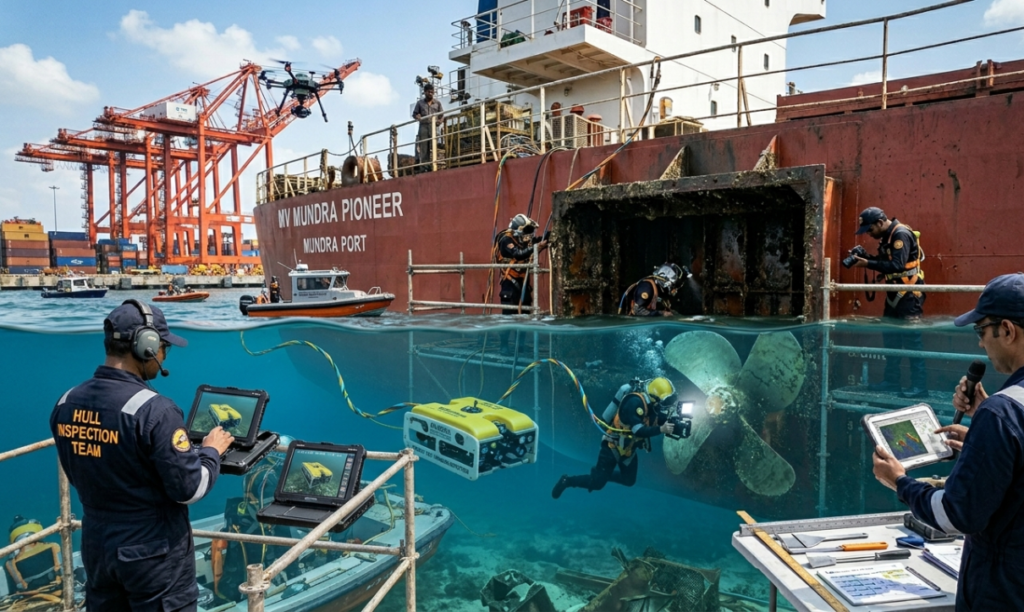
Initial Hull Assessment
Before cleaning begins, divers conduct a detailed inspection to evaluate:
- Fouling severity
- Hull coating condition
- Areas requiring special attention
- Potential damage or corrosion
Underwater cameras and video recording systems are commonly used to document the hull condition.
Cleaning Operations
Depending on vessel type and fouling level, cleaning may involve:
- Soft-brush cleaning systems
- Rotary brush equipment
- Specialized non-abrasive cleaning tools
- Diver-operated cleaning units
The objective is to remove marine growth while protecting the vessel’s anti-fouling coating.
Final Inspection
After cleaning, divers conduct a post-service inspection to verify cleaning effectiveness and identify any structural concerns that may require attention.
Many operators also request photographic reports for maintenance records and fleet management purposes.
Key Benefits of Underwater Hull Cleaning
Improved Fuel Efficiency
A smooth hull significantly reduces resistance through water.
Industry studies have consistently shown that excessive fouling can increase fuel consumption by 10% to 30% or more depending on severity. Removing marine growth helps restore vessel performance and lowers operating costs.
Reduced Carbon Emissions
As environmental regulations become increasingly stringent, shipping companies are under pressure to improve sustainability.
Regular Underwater Hull Cleaning in Pipavav contributes to lower fuel consumption, which directly reduces carbon emissions.
Better Vessel Performance
Clean hull surfaces allow ships to maintain designed speeds and improve propulsion efficiency.
This becomes particularly important for container vessels operating on fixed schedules where maintaining transit times is critical.
Extended Coating Life
When performed correctly, underwater cleaning helps maintain hull coatings by preventing excessive fouling accumulation that could otherwise damage protective systems.
Cost Savings
Compared to the long-term costs associated with increased fuel consumption, routine underwater cleaning is often a highly cost-effective maintenance measure.
Environmental Considerations
Environmental responsibility is now a major focus within the shipping industry.
Modern providers of Underwater Hull Cleaning in Pipavav follow established procedures designed to minimize environmental impact.
Key considerations include:
Biofouling Management
Marine organisms removed from vessel hulls must be managed responsibly to prevent the spread of invasive aquatic species.
Coating Protection
Aggressive cleaning methods can damage anti-fouling coatings and release paint particles into the marine environment. Professional operators use appropriate cleaning techniques to minimize this risk.
Regulatory Compliance
Shipowners increasingly seek service providers that comply with local port requirements and international environmental guidelines.
Choosing the Right Hull Cleaning Service Provider
Not all underwater cleaning operations deliver the same results.
When selecting a provider for Underwater Hull Cleaning in Pipavav, vessel operators should evaluate:
Experience in Commercial Diving
Qualified commercial diving teams understand vessel structures, underwater safety procedures, and marine maintenance requirements.
Equipment Quality
Advanced cleaning equipment helps achieve efficient cleaning while minimizing coating damage.
Safety Standards
A reputable provider follows established diving safety protocols and operational risk assessments.
Inspection and Reporting
Detailed inspection reports help shipowners track hull condition and maintenance history.
Response Time
For vessels operating on tight schedules, rapid service availability can be a critical advantage.
The Growing Importance of Hull Maintenance in Modern Shipping
The shipping industry continues to focus on fuel efficiency, emissions reduction, and operational optimization.
As fuel costs remain a major expense for vessel operators, maintaining a clean hull is no longer viewed as optional maintenance. It has become a practical business decision.
Ports like Pipavav are increasingly supporting marine maintenance activities that help shipowners achieve better performance while reducing environmental impact.
Whether for tankers, bulk carriers, container ships, offshore vessels, or coastal fleets, regular underwater cleaning contributes directly to safer and more efficient maritime operations.
Conclusion
Underwater Hull Cleaning in Pipavav has become an essential service for shipowners looking to maximize vessel efficiency, reduce fuel costs, and maintain environmental compliance. By removing marine growth without requiring dry docking, underwater cleaning offers a practical and cost-effective maintenance solution.
As global shipping moves toward greater sustainability and operational efficiency, proactive hull maintenance will continue to play a critical role. For vessels operating along India’s western coast, Pipavav provides a strategically located hub where professional underwater cleaning services can help keep fleets performing at their best.
FAQs
Q1. What is underwater hull cleaning?
Underwater hull cleaning is the process of removing marine growth such as algae, slime, barnacles, and other fouling organisms from a vessel’s submerged hull while the ship remains afloat.
Q2. Why is underwater hull cleaning important for ships?
Hull cleaning reduces drag, improves fuel efficiency, lowers emissions, enhances vessel speed, and helps maintain overall operational performance.
Q3. How often should a vessel undergo underwater hull cleaning?
The frequency depends on trading routes, water conditions, vessel type, and coating performance. Many operators schedule inspections every few months to assess fouling levels.
Q4. Can underwater hull cleaning damage hull coatings?
When performed by experienced professionals using proper equipment, cleaning can be carried out safely while preserving the vessel’s anti-fouling coating.
Q5. Which vessels can benefit from underwater hull cleaning in Pipavav?
Container ships, bulk carriers, tankers, offshore support vessels, coastal cargo ships, and other commercial vessels can benefit from regular underwater hull cleaning services.