
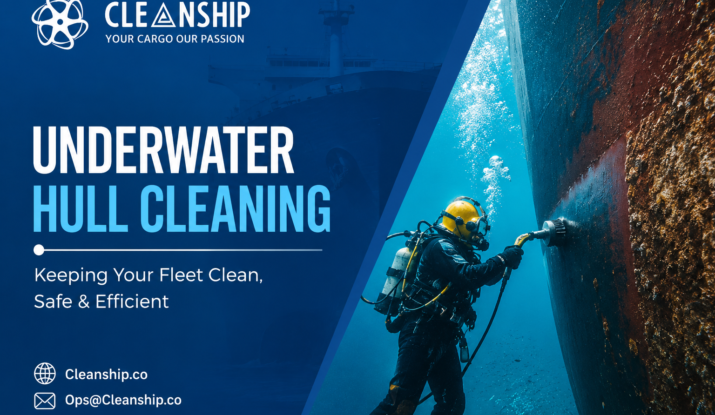
Introduction: Why Underwater Hull Cleaning Matters Across Global Ports
Every day your vessel sits at anchor or in port without a clean hull, it is burning more fuel than it needs to. Marine biofouling — barnacles, algae, slime, and other organisms — builds up silently on submerged surfaces, creating drag that can increase fuel consumption by 10% to 40%. In a market where fuel accounts for more than 50% of a vessel’s operating costs, this is not a minor inconvenience. It is a direct threat to your commercial margins.
Think of underwater hull cleaning the same way you would think of tyre maintenance on a truck. A driver who ignores tyre pressure pays more at the pump, wears out components faster, and risks losing control. A ship operator who ignores underwater hull cleaning pays more in bunkers, damages the propeller shaft, and risks failing a port state control inspection.
At Cleanship Marine Services, we provide professional underwater hull cleaning and propeller polishing services at eight of the world’s most critical maritime hubs: Dubai, Athens, Singapore, Hong Kong, London, Hamburg, Istanbul, and Mumbai. Here is why this service is not optional — it is essential.
What Is Underwater Hull Cleaning? (A Simple Explanation)
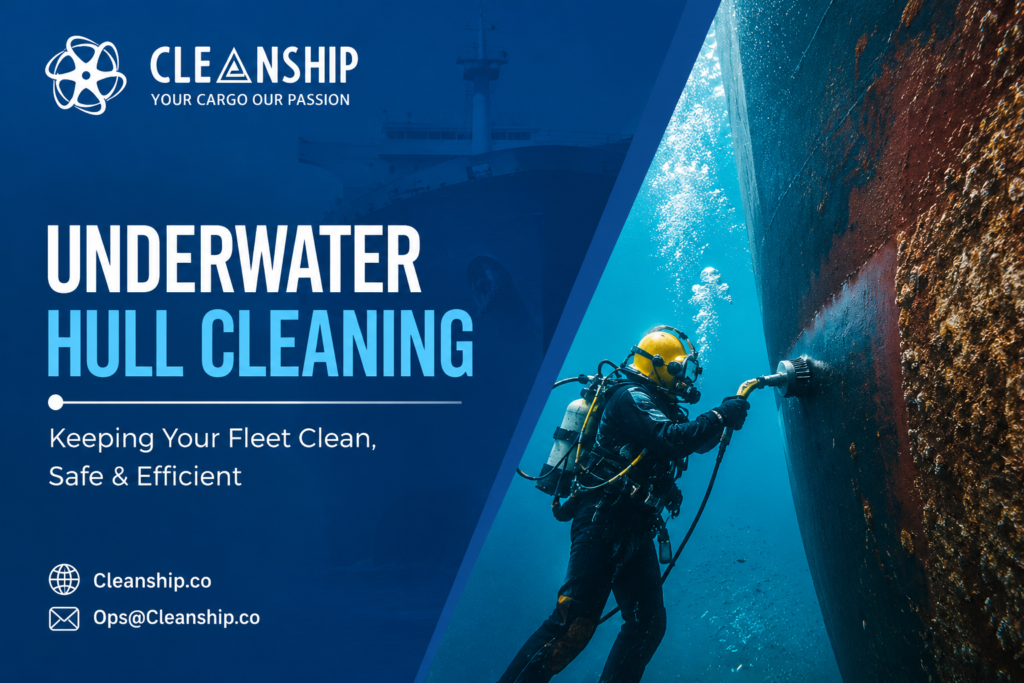
Underwater hull cleaning is the systematic removal of biofouling, marine growth, and sediment from a vessel’s submerged surfaces — the hull plating, rudder, sea chests, and propeller — without the need for drydocking. Trained commercial divers using rotating brush units, high-pressure water tools, and surface preparation equipment perform the work while the vessel floats in harbour.
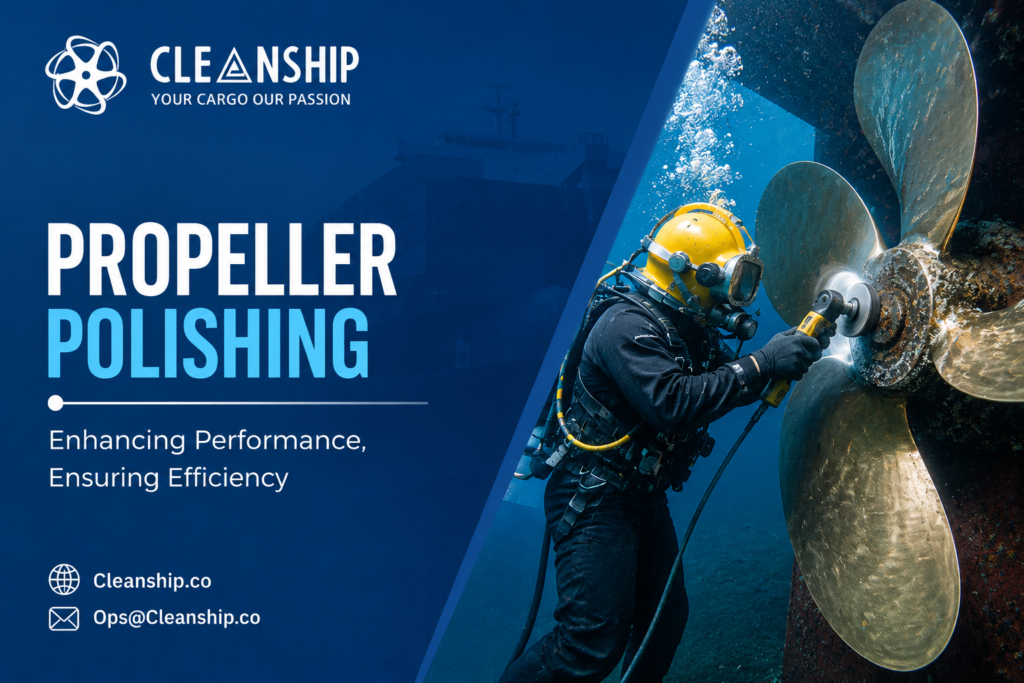
Propeller polishing is a related process in which the propeller blades are cleaned to their original hydrodynamic profile and finish. Even microscopic surface roughness on a propeller blade increases fuel consumption and reduces thrust efficiency. Combining underwater hull cleaning with propeller polishing addresses both drag and propulsion performance in a single operation.
The Regulatory Framework Governing Underwater Hull Cleaning
Before examining the benefits, it is important to understand the compliance environment your vessel operates in at each of our target ports.
IMO Biofouling Guidelines (MEPC.207(62)) The International Maritime Organization has adopted guidelines for the management of biofouling to minimise the transfer of invasive aquatic species. Ports in Singapore, Hong Kong, London, and Hamburg increasingly expect documented biofouling management plans.
MARPOL Convention MARPOL regulates how wash water and residues from hull cleaning are handled. Uncontrolled discharge of paint particles, organisms, and biocides is a growing focus of port authority inspections in Dubai, Athens, and Istanbul.
Local Port Regulations Each target port carries its own specific requirements. The Maritime and Port Authority of Singapore, the Dubai Maritime City Authority, and the Port of Hamburg Authority all have active frameworks around hull management and underwater cleaning methods.
Cleanship’s underwater hull cleaning operations are conducted in full alignment with these frameworks, with complete documentation provided after every dive.
Benefit 1: Significant Fuel Savings Across Every Route
Biofouling does not build up uniformly. It is most aggressive in warm, nutrient-rich waters — precisely the conditions found in Dubai, Mumbai, Singapore, and Hong Kong. A vessel trading between these ports can accumulate heavy fouling within weeks.
Professional underwater hull cleaning restores the vessel’s hydrodynamic efficiency. Industry data consistently shows that cleaning a heavily fouled hull can reduce fuel consumption by 10% to 25% on a single voyage. When combined with propeller polishing, the cumulative savings over a calendar year are substantial enough to offset the cost of cleaning many times over.
For fleet operators managing Aframax tankers, Panamax bulkers, or large container vessels through the Suez Canal corridor, the Straits of Malacca, and the English Channel, this efficiency improvement translates directly to competitive freight rates and improved voyage profitability.
Benefit 2: Full Compliance with International and Local Port Regulations
Regulatory non-compliance is one of the fastest ways to lose commercial credibility. Port State Control officers in London (MCA), Hamburg (BSH), Singapore (MPA), and Hong Kong (MARDEP) have the authority to detain a vessel if its biofouling management plan is inadequate or its hull condition poses an invasive species risk.
Professional underwater hull cleaning at Cleanship provides:
- Pre-dive and post-dive inspection reports
- Photographic and video documentation of hull condition
- MARPOL-compliant waste collection and disposal records
- Biofouling management plan support documentation
- Cleaning method statements aligned with local port authority requirements
This documentation trail is the difference between a smooth port state control inspection and a costly detention in Piraeus, Istanbul, or Mumbai.
Benefit 3: Extended Antifouling Coating Life
Modern antifouling paints are expensive. Depending on the vessel size and coating specification, a full drydock antifouling application can cost hundreds of thousands of dollars. How that coating performs over its service life depends heavily on how well it is maintained between drydock intervals.
Heavy biofouling allowed to anchor on the coating surface physically damages the paint. When it is removed without proper technique, the coating integrity is further compromised. Professional underwater hull cleaning using calibrated soft-brush rotating units removes marine growth while preserving the antifouling film beneath.
At busy trading ports like Singapore and Hong Kong, where vessels may sit at anchorage for several days waiting for berth allocation, preventive in-water cleaning before significant fouling takes hold is the most cost-effective approach to coating preservation.
Benefit 4: Improved Propulsion Performance Through Propeller Polishing
A clean hull with a rough propeller is like polished running shoes with broken laces. You get only part of the benefit.
Propeller polishing is the companion service to underwater hull cleaning that most operators underestimate. Marine growth on propeller blades creates uneven loading, increases shaft vibration, and generates unnecessary cavitation. Even a light fouling layer on blade surfaces can increase fuel consumption by 5% to 8% independently of hull condition.
Propeller polishing performed by Cleanship’s specialist divers restores blade surfaces to near-original roughness values, improving:
- Thrust efficiency and vessel speed at a given RPM
- Main engine loading and fuel burn
- Shaft bearing wear rates
- Vibration levels (important for crew comfort and machinery longevity)
In Athens (Piraeus), Hamburg, and London, where vessels are frequently under charter party speed and consumption warranties, propeller polishing is not a luxury — it is a contractual protection.
Benefit 5: Prevention of Invasive Species Transfer Between Ports
This benefit is increasingly important as port authorities in Singapore, Hong Kong, and Hamburg tighten biosecurity enforcement. Fouled hulls carry living organisms from one marine environment to another. In some jurisdictions, vessels with excessive biofouling can now be refused entry or required to clean in designated areas before berthing.
Cleanship’s underwater hull cleaning removes the biological layer before your vessel moves from one trading region to another, protecting both the environment and your operating schedule. Our waste containment procedures ensure that removed marine growth and residues are properly collected rather than released into port waters.
Benefit 6: Reduced Main Engine Wear and Machinery Maintenance Costs
Increased hull resistance caused by biofouling forces the main engine to work harder to maintain charter speed. Operating an engine at consistently higher load accelerates wear on cylinder liners, piston rings, turbochargers, and fuel injection equipment.
Regular underwater hull cleaning and propeller polishing reduce the power demand on the main engine, extending the intervals between major overhauls and reducing spare parts expenditure. For vessels operating in demanding environments — such as the Mumbai coastal trades, the Istanbul Strait transits, or the North Sea routes out of Hamburg and London — keeping the propulsion system within its designed operating envelope is a key element of preventive maintenance.
Benefit 7: Commercial Credibility with Charterers, Inspectors, and Port Authorities
A vessel that arrives at Jebel Ali (Dubai), Singapore, or Piraeus (Athens) with documented hull cleaning records is a vessel that charterers trust. Inspection surveyors and supercargo professionals notice the difference between a ship that is consistently maintained and one that is not.
The commercial benefits of a proactive underwater hull cleaning programme include:
- Faster cargo readiness approvals at loading ports
- Better performance in speed and consumption claims under charter parties
- Stronger position in post-voyage performance disputes
- Improved vessel reputation in the sale-and-purchase market
Clean hulls signal operational discipline. In today’s competitive freight market, that reputation is a commercial asset.
Port-by-Port Overview: Underwater Hull Cleaning at Our 8 Key Locations
| Port | Key Challenge | Why Cleanship |
|---|---|---|
| Dubai (Jebel Ali / Rashid) | High water temperatures accelerate biofouling year-round | Rapid mobilisation, full DMCA-compliant documentation |
| Athens (Piraeus) | Charter party performance warranties, busy anchorage | Speed and efficiency; propeller polishing specialists |
| Singapore | MPA biosecurity requirements; warm, fouling-aggressive waters | Full compliance documentation; MPA-aligned procedures |
| Hong Kong | MARDEP inspections; Pearl River Delta traffic | Experienced dive teams; short-notice deployment |
| London (Thames / Tilbury) | MCA oversight; North Sea operational demands | Detailed reporting aligned with UK port authority requirements |
| Hamburg | BSH environmental standards; strict waste management | MARPOL-compliant waste containment; eco-friendly methods |
| Istanbul | Bosphorus transit compliance; Black Sea fouling conditions | Local regulatory knowledge; fast turnaround |
| Mumbai | MTNL port regulations; warm Indian Ocean biofouling | Established local operations; IMO-compliant methods |
Underwater Hull Cleaning vs. Drydock: Understanding the Difference
| Factor | In-Water Hull Cleaning | Drydock |
|---|---|---|
| Vessel off-hire | Minimal (hours) | 10–20+ days |
| Cost | Significantly lower | High |
| Frequency | Every 3–6 months as needed | Every 2.5–5 years |
| Coating application | Not possible | Full coating renewal possible |
| Regulatory purpose | Maintenance and compliance | Major repairs and full renewal |
| Propeller polishing | Yes — included | Yes — full overhaul available |
In-water underwater hull cleaning is the preventive strategy that makes each drydock interval count. It is not a substitute for drydock — it is what protects your investment between drydock periods.
How Cleanship Conducts Underwater Hull Cleaning
Our standard operational workflow:
Step 1 — Pre-Dive Survey Cleanship divers conduct a visual inspection and condition assessment before cleaning begins. The hull condition is documented photographically.
Step 2 — Equipment Mobilisation Rotating brush cleaning units, surface preparation tools, and waste containment equipment are deployed alongside the vessel.
Step 3 — Hull Cleaning Systematic cleaning proceeds from stem to stern, including the waterline band, boot topping, flat bottom, bilge keel, rudder, sea chests, and stern frame.
Step 4 — Propeller Polishing Propeller blades are cleaned to hydrodynamic profile using specialist polishing tools. Blade surface condition is documented before and after.
Step 5 — Post-Dive Report A full post-cleaning report is issued, including photographic evidence, cleaning method details, waste disposal confirmation, and hull condition assessment.
Step 6 — Documentation Handover All compliance documentation is provided to the vessel’s master and can be transmitted directly to the operator or charterer.
Future Trends in Underwater Hull Cleaning
Robotic and Remote-Operated Cleaning ROV-based hull cleaning systems are entering service at major ports, allowing inspection and light cleaning without diver deployment. Cleanship continues to evaluate these technologies as supplements to professional dive operations.
Real-Time Hull Performance Monitoring Digital hull performance monitoring systems — increasingly required under EU MRV and IMO DCS reporting — create demand for documented, dated cleaning records. Cleanship’s post-cleaning reports are designed to integrate with these digital reporting requirements.
Eco-Friendly Waste Management Ports in Hamburg, London, and Singapore are progressively tightening requirements around the collection of biofouling residues. Cleanship’s waste containment procedures are ahead of these emerging requirements.
Key Takeaways for Ship Operators and Fleet Managers
- Underwater hull cleaning and propeller polishing are preventive maintenance services with measurable ROI in fuel savings and coating preservation.
- Compliance documentation is as important as the physical cleaning — Cleanship provides both.
- The 8 ports we serve — Dubai, Athens, Singapore, Hong Kong, London, Hamburg, Istanbul, and Mumbai — represent some of the world’s most demanding regulatory and commercial environments.
- In-water cleaning does not replace drydock but maximises performance and compliance between drydock intervals.
- Propeller polishing combined with hull cleaning addresses both drag and propulsion efficiency in a single mobilisation.
Conclusion
Underwater hull cleaning and propeller polishing are not optional maintenance tasks for vessels trading through Dubai, Athens, Singapore, Hong Kong, London, Hamburg, Istanbul, and Mumbai. They are compliance requirements, commercial necessities, and fuel efficiency investments in one combined operation.
First, they keep your vessel aligned with the increasingly strict biofouling and environmental regulations applied at each of these major ports. Second, they protect antifouling coating integrity and reduce long-term drydock costs. Third, they deliver measurable fuel savings and propulsion performance improvements that directly strengthen your commercial position under charter parties and voyage estimates.
If you are looking for a professional underwater hull cleaning partner with documented compliance procedures, experienced dive teams, and proven performance across global ports, contact Cleanship Marine Services today.
FAQs
Q1. How often should underwater hull cleaning be performed?
The recommended frequency depends on the vessel’s trading area, antifouling paint specification, and port authority requirements. In warm-water ports such as Dubai, Singapore, and Mumbai, quarterly cleaning is often advisable. In cooler waters such as London and Hamburg, six-monthly intervals may be appropriate. Cleanship will recommend a schedule based on your vessel’s profile.
Q2. Is underwater hull cleaning mandatory?
It is not universally mandated as a specific interval requirement, but IMO biofouling management guidelines are increasingly being adopted into national regulations. Singapore, Hong Kong, and several European ports now expect documented biofouling management plans. Failure to manage hull fouling can result in refusal of entry or port state control detention.
Q3. What is propeller polishing and why is it done at the same time as hull cleaning?
Propeller polishing is the smoothing of propeller blade surfaces to restore their design hydrodynamic finish. It is performed during the same dive operation as hull cleaning because both services require diver access to the vessel’s underwater surfaces. Combining them minimises vessel off-hire and optimises the cost per dive mobilisation.
Q4. Will underwater hull cleaning damage my antifouling paint?
When performed correctly using properly calibrated soft-brush rotating tools by trained divers, underwater hull cleaning does not damage antifouling coatings. Cleanship divers are trained in coating-sensitive cleaning methods and will document hull condition before and after to confirm coating integrity.
Q5. Can Cleanship provide documentation for port state control and charterer reporting?
Yes. Cleanship provides a complete post-cleaning documentation package including inspection photographs, cleaning method statement, waste disposal confirmation, and hull condition assessment. This documentation supports biofouling management plan compliance and charter party performance reporting.
Q6. Does Cleanship operate at ports outside the 8 listed locations?
Cleanship’s primary service hubs are Dubai, Athens, Singapore, Hong Kong, London, Hamburg, Istanbul, and Mumbai. For enquiries regarding other ports, please contact our operations team directly at ops@cleanship.co.